
Fujifilm X-T5
APS‑C mirrorless for photographers prioritising image quality and handling
A high‑resolution APS‑C camera in Fujifilm's X series targeted at stills photographers who value image quality, film simulations and traditional control layout. Sits above the X‑T30/40 class and below flagship medium‑format and full‑frame options.
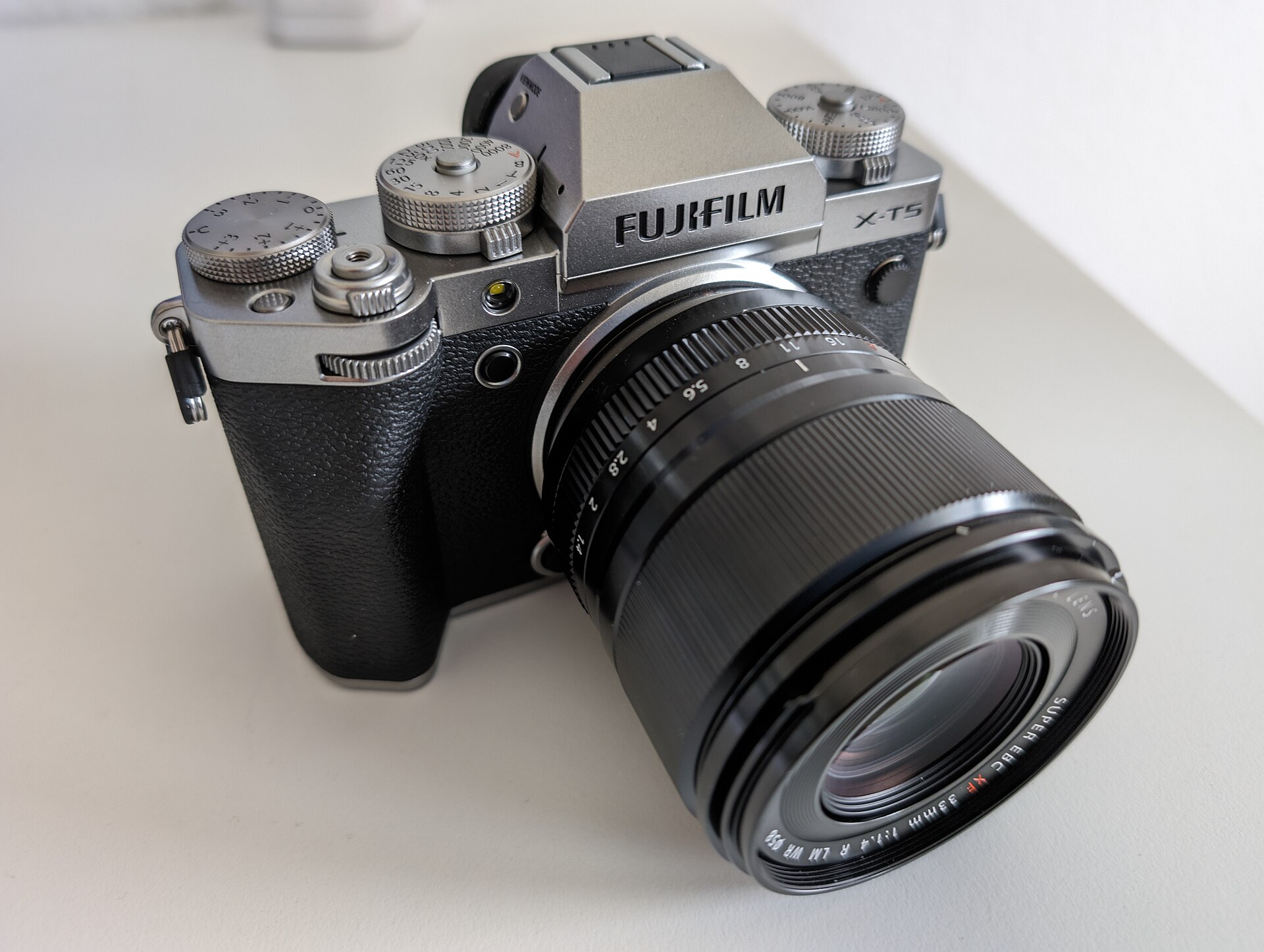
Photo: Müllowitsch via Wikimedia Commons, licensed under CC0.
A 40.2MP, stills‑first X‑Series camera for photographers who prioritise image quality and handling; the catch is no in‑body stabilisation and extra cost for lenses that make the most of its sensor.
01 / 05Who the X‑T5 suits — and who should look elsewhere
The X‑T5 is aimed squarely at photographers who want a high‑resolution APS‑C sensor in a compact, tactile body with Fujifilm’s traditional dials and film simulations. Its 40.2MP X‑Trans CMOS 5 HR sensor and X‑Processor 5 mean it produces very high‑detail stills and supports features like Pixel Shift for producing very large composite files — attributes that suit landscape, studio and commercial stills shooters who prioritise image quality over body ergonomics or video‑centric features. Fujifilm’s product pages emphasise the sensor and stills‑oriented feature set as the core selling points. fujifilm-x.com
The camera is less suitable for run‑and‑gun hybrid shooters and many videographers. Independent reviews from DPReview and Imaging Resource note that while the X‑T5 offers 6.2K/4K video options, it is primarily a stills camera in ergonomics and tuning; Fujifilm omitted in‑body image stabilisation (IBIS), so shooters relying on slower shutter speeds or long primes will either need lens IS or a tripod. For fast action and low‑light sports, the X‑T5’s strengths are more limited than Fujifilm’s X‑H series or rivals with IBIS and larger buffers. dpreview.com
02 / 05What your money buys compared with obvious alternatives
Because you didn’t give a list price we’re not inventing one: street prices vary by retailer and region. What you get instead is a high‑resolution APS‑C package with Fujifilm’s refined colour science, a rich set of JPEG presets and tactile controls that many photographers prefer to menu‑heavy designs. Reviews consistently praise the image quality and resolution for texture and printability, emphasising that the X‑T5 narrows the gap between APS‑C and many full‑frame offerings for still‑image applications. DPReview called its images class‑leading among APS‑C bodies on detail and colour. dpreview.com
Compared with the X‑H2 or full‑frame rivals, the trade‑offs are clear: the X‑H2 leans more to hybrid/video work with different ergonomics and features, while full‑frame cameras offer shallower depth of field and, in some cases, better high‑ISO performance. Digital Camera World and TechRadar’s coverage frames the X‑T5 as the choice when handling, resolution and classic controls matter more than absolute low‑light headroom or in‑body stabilisation. In short, the X‑T5 buys you Fujifilm character and resolution rather than spec‑sheet dominance. digitalcameraworld.com
03 / 05Where the X‑T5 is weakest
The most immediate hardware limitation is the lack of in‑body image stabilisation. Fujifilm chose to rely on optical stabilisation in lenses and conventional support for long exposures; multiple reviewers flagged that omission as the main practical drawback for handheld low‑light work or telephoto shooting. Imaging Resource and DPReview stress that without lens IS or a tripod, the benefit of the 40MP sensor can be hard to exploit at slow shutter speeds. imaging-resource.com
Other practical compromises include a smaller buffer and handling quirks for larger hands compared with bulkier bodies, and while video capability exists (6.2K oversampled and 4K up to 60p), reviewers treat video as capable rather than best‑in‑class. Several outlets mention that autofocus is good for stills and much improved over earlier X‑T models, but it is not necessarily the fastest or most reliable for tightly paced sports compared with specialist action bodies. These are trade‑offs — the X‑T5 is optimised for high‑quality stills with Fujifilm’s look rather than every professional workflow. digitalcameraworld.com
04 / 05What it really costs to use (lenses, cards, batteries)
Buying the body is only the start. To make the most of the 40.2MP sensor you’ll want sharp native XF lenses — especially primes or the newer high‑resolution zooms — and many of those premium Fujinon XF lenses sit at mid‑to‑high price points. Digital Camera World and other buying guides recommend pairing the X‑T5 with the sharper, newer lens designs if you need corner‑to‑corner performance, which raises the effective cost of the system. digitalcameraworld.com
Expect to budget for fast UHS‑II SD cards if you shoot large RAW files or use burst modes, and spares: the 40MP files and optional Pixel Shift outputs are storage‑hungry. Battery life is reasonable for an APS‑C mirrorless camera, but running high‑resolution stills and video will increase consumption; reviewers suggest carrying at least one spare battery for day trips. In short, platform costs can exceed the body price quickly: lenses, high‑speed cards and spare batteries are the most immediate additional expenses. app.fujifilm-dsc.com
05 / 05Closing verdict
The Fujifilm X‑T5 is a clearly argued camera: it prioritises image quality, resolution and classic Fujifilm handling over in‑body stabilisation or being the best video/action tool on the market. Independent reviews consistently praise its stills performance, colour science and the tactile control scheme that many photographers prefer, while pointing out the practical penalties if you need handheld low‑light or fast‑action capabilities without complementary lens IS. If you value high‑resolution APS‑C files and the Fujifilm shooting experience, the X‑T5 is hard to ignore. dpreview.com
However, buyers should budget for good lenses and storage, and be aware that rival bodies — including Fujifilm’s own X‑H series or cameras with IBIS — may be a better fit for hybrid shooters or those who primarily need handheld low‑light performance. Prices vary by retailer, so shop around for the best street price and remember to factor in the lenses and accessories you’ll need to realise the sensor’s potential. digitalcameraworld.com
The honest summary
After every long-form review, we publish the two-sided summary. What proved durable, and what failed during testing.
What held up
3 items- +40.2MP X‑Trans CMOS 5 HR sensor delivers very high stills resolution and detail
- +Classic, tactile controls and Fujifilm colour science that many photographers prefer
- +Strong JPEG and film simulation options with Pixel Shift for large composite files
What broke
3 items- −No in‑body image stabilisation — reliance on lens IS or tripod for slow‑shutter work
- −System costs rise quickly once you add sharp XF lenses and fast SD cards
- −Not the best choice for fast‑action sports or shooters who need class‑leading video features
What it actually costs
Manufacturer list prices. Retailers discount constantly, so treat these as the figure to judge an offer against rather than what you should pay.
List price
Body only. Manufacturer list price — retailers vary and discount often.
What to check before buying Fujifilm X-T5
Hardware is bought once and lived with for years. The purchase price is the part everyone compares, and rarely the part that decides what it costs you.
What it has actually sold for
The manufacturer lists it at $1699.95, and on hardware that figure moves constantly at retail. Treat it as the figure to judge an offer against, not what you should expect to pay.
Where it sits in the release cycle
A model about to be replaced is discounted for a reason, and one just launched carries a premium that fades within months. Knowing which you are looking at is worth more than any coupon.
What it needs that it does not come with
Cases, cards, cables, batteries, lenses, mounts, subscriptions. In some categories the accessories cost more across two years than the item did, and none of it is on the price tag.
Returns, warranty, and who honours it
The return window, the warranty length, and whether the manufacturer or the seller handles a fault. A grey-market price often buys a warranty that is harder to claim against.
These are the checks we apply across cameras, in the same order, so two pages can be compared line for line.
How much does Fujifilm X-T5 really cost?
Our calculation from the vendor's published prices — not a figure the vendor advertises.
No paid plan with a published price.
- Pricing model not yet verified.
- No paid plan price is published on this page.
Work out your own cost
Fujifilm X-T5 against the field
The highest-scoring alternatives in the same category, compared on the figures we hold for all of them.
| Fujifilm X-T5This page | OM SYSTEM OM‑1 | Panasonic Lumix DC‑S5 II | |
|---|---|---|---|
| ReviewCost score | — | — | — |
| Cheapest plan | List price | — | — |
| From | — | — | — |
| Renews at | Not published | Not published | Not published |
| Biggest strength | Landscape and portrait photographers | Bird and wildlife photographers wanting high burst rates | Video creators needing compact full‑frame |
| Biggest drawback | No in‑body image stabilisation | Smaller sensor vs APS‑C and full‑frame cameras | AF may trail top competitors in some scenarios |
Prices are the published figures at the time of writing and change often. Renewal pricing is shown where the vendor publishes it. See how we review.
What people ask about Fujifilm X-T5
Straight answers to what buyers actually ask, drawn from the documentation and published user reports.
Does the X‑T5 have in‑body image stabilisation (IBIS)?
Can the X‑T5 shoot 4K and high framerate video?
Is the X‑T5 better than Fujifilm’s X‑H2?
Page history
- Published
- 2 October 2026
- Last updated
- 2 October 2026
- Pricing checked against vendor
- 2 October 2026
Sources & verification
Pricing on this page was taken from the vendor's published pricing page on 2 October 2026.
- Fujifilm X-T5 — manufacturer priceOfficial pricing page · Fujifilm · read 2 October 2026