
Canon EOS R10
APS-C mirrorless for enthusiast photographers and hybrid shooters
A mid‑range APS‑C mirrorless camera in Canon's EOS R line aimed at enthusiasts who want fast burst shooting and 4K video. Sits below Canon's full‑frame EOS R models and above entry‑level EOS M / R models.
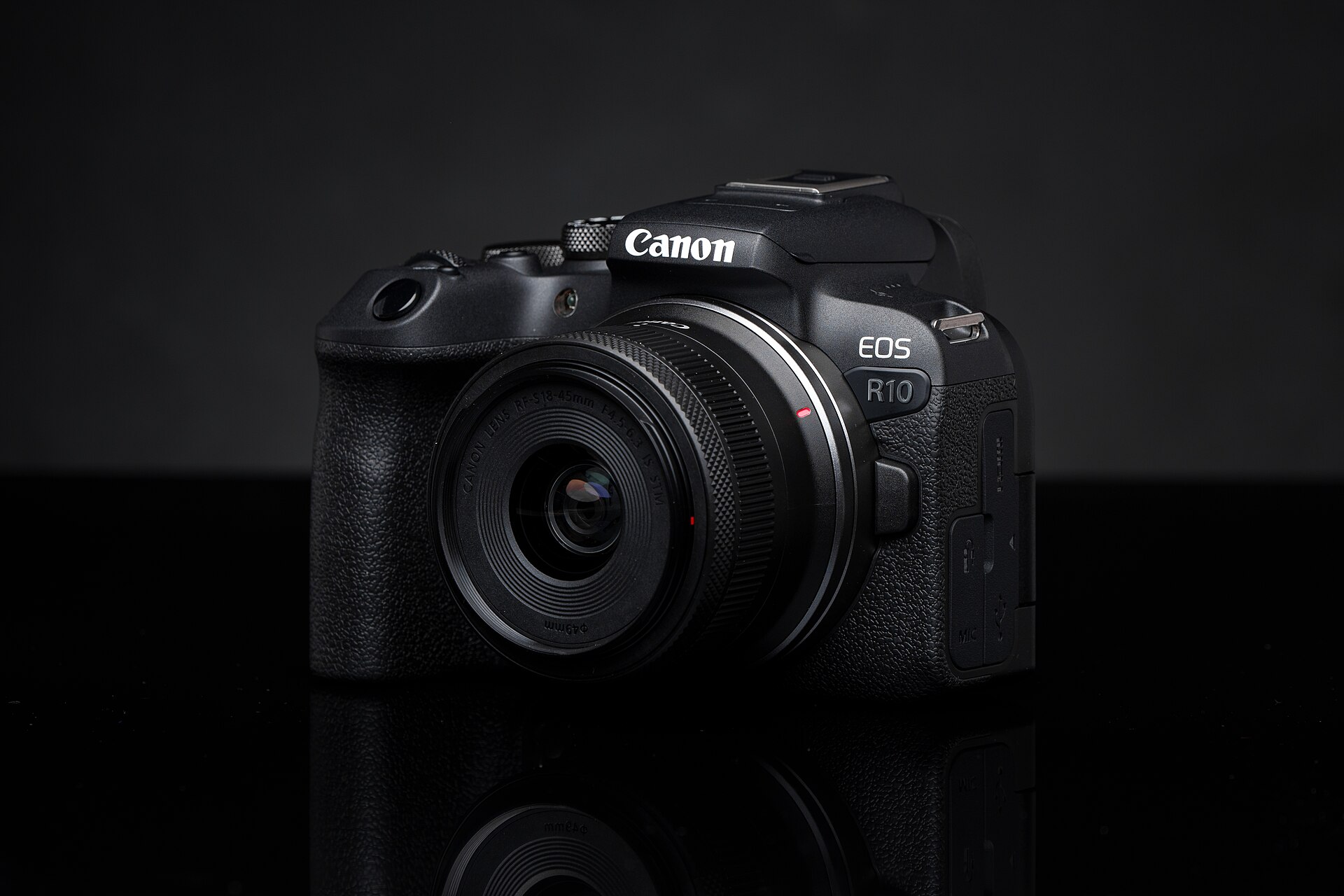
Photo: Henry Söderlund from Helsinki, Finland via Wikimedia Commons, licensed under CC BY 2.0.
A compact, speedy APS‑C RF camera that buys autofocus and frame‑rate performance — but lacks IBIS and needs thoughtful lens/battery spend.
01 / 05Who the R10 suits — and who it does not
The EOS R10 is aimed at photographers and videographers who want a lightweight, fast APS‑C body with modern Canon autofocus and an RF lens ecosystem. It pairs a 24.2MP APS‑C CMOS sensor with Canon’s Dual Pixel CMOS AF II and very rapid continuous shooting (up to 15fps with the mechanical shutter, 23fps electronically), which makes it well suited to action, wildlife and event shooters who value reach, subject tracking and high burst throughput in a small package. Canon’s announcement framed the R10 as an entry‑level APS‑C RF body that nevertheless borrows features from higher‑end models. usa.canon.com
It is less suitable for photographers who need in‑body image stabilisation (IBIS) or the absolute best low‑light/high‑ISO performance available from larger‑pixel full‑frame sensors. The R10 has no IBIS, so steady handheld shooting for longer telephoto or low‑shutter situations depends on lens IS or higher ISOs. Likewise, videographers who demand full‑width 4K/60p without a sensor crop or those who prioritise long continuous 10‑bit 4:2:2 recordings under heavy heat may prefer larger Canon bodies or competitors with IBIS and full‑width 4K/60p. imaging-resource.com
02 / 05What the money buys compared with obvious alternatives
At the listed body‑only price of USD 1,099, the R10 sits below Canon’s R7 and above basic entry models in terms of speed and video features. Compared with the R7 (a higher‑end APS‑C sibling), the R10 is lighter and cheaper but drops sensor resolution and in some cases performance specs; compared with full‑frame options the R10 offers the APS‑C crop advantage for reach and smaller, lighter lenses at lower cost. Reviewers noted the R10’s competitive advantage is its burst rates and modern AF in a sub‑$1,000 to $1,200 range when bundled or on promotion. usa.canon.com
Against rival APS‑C mirrorless bodies from Sony or Fujifilm, the R10’s strengths are Canon’s subject detection AF and integration with new RF‑mount lenses; rivals may offer IBIS, different colour science or higher native video performance without crop. Choosing the R10 makes most sense if the Canon lens roadmap (and Canon AF behaviour) matters to you, and if you prioritise burst/AF performance and ergonomics over in‑body stabilisation or the ultimate low‑light sensor advantage. Independent reviews emphasise this positioning rather than claiming it as a universal best buy. digitalcameraworld.com
03 / 05Where the R10 is weakest
The most obvious limitations are the lack of in‑body image stabilisation and the 4K/60p mode’s crop. Canon’s specifications and reviewers both point to the absence of IBIS, so handheld stills or video at longer focal lengths rely on lens IS or higher shutter speeds and ISOs. The R10 records 4K up to 60p, but at 60p the camera uses a crop from the sensor, reducing the field of view and effectively increasing focal length — a benefit for reach but a drawback for wide shots and some video workflows. downloads.canon.com
Battery life and heat limits are practical weak points for heavy users. Canon and reviewers mention limits on continuous recording times under certain conditions and that shooters should expect to buy spare batteries and a fast UHS‑II card for some video modes and high‑speed burst RAW capture. Finally, while autofocus is strong in many reviews, no camera is perfect at every tracking scenario; independent reviewers recommend checking sample galleries and video tests for your subject type before deciding. imaging-resource.com
04 / 05What it costs to actually use — lenses, cards and batteries
The $1,099 body price is only the starting point. Useful RF‑mount lenses for APS‑C can vary widely in price: a basic RF‑S 18‑45mm kit lens or RF 24‑105 equivalents for full‑frame adaptors will add several hundred dollars; lightweight telephoto RF‑S zooms or adapted EF/EF‑S telephotos will be additional investments if you want to exploit the R10’s high burst rates for wildlife or sports. Canon’s own launch materials and retail listings show kit and bundle pricing that reduces initial outlay, but most buyers should budget at least one additional lens in the $300–$900 range to make the system versatile. usa.canon.com
For video and high‑speed RAW bursts you should plan for UHS‑II SD cards or V60/V90 cards depending on codec and rate; reviewers note that high bit‑rate recording and ALL‑I modes benefit from faster media. Spare LP‑E17 batteries (or compatible third‑party alternatives) are also recommended for all‑day shooting; reviewers commonly report that heavy continuous shooting or video will exhaust a single battery before a long session ends. Factor in a small bag, spare media and power for a realistic total cost of ownership. imaging-resource.com
05 / 05Verdict: a strong choice if you value speed and Canon AF
The Canon EOS R10 is a compact, fast APS‑C mirrorless camera that delivers modern Dual Pixel AF, high burst rates and solid 4K video features at a price that undercuts many higher‑end models. Independent reviews highlight the camera’s value for hybrid shooters who want good stills AF, reach from the APS‑C crop and flexible video modes without a large or heavy body. If these are your priorities, the R10 represents sensible value in Canon’s RF lineup. dpreview.com
However, buyers who need IBIS, full‑width uncropped 4K/60p, or the best high‑ISO performance from a full‑frame sensor should consider alternatives (including higher‑end Canon bodies or rival brands) rather than stretch this camera beyond its intended role. Final decision should weigh lens costs and whether lens‑based IS and Canon’s AF behaviour suit your subjects; if they do, the R10 will reward with speed and compact handling. imaging-resource.com
The honest summary
After every long-form review, we publish the two-sided summary. What proved durable, and what failed during testing.
What held up
4 items- +Fast continuous shooting (up to 15fps mechanical, 23fps electronic)
- +Canon Dual Pixel CMOS AF II with strong subject detection
- +Compact, lightweight APS‑C body and access to RF lens ecosystem
- +4K video up to 60p (useful crop for reach) and 1080p at 120p
What broke
4 items- −No in‑body image stabilisation (relies on lens IS)
- −4K/60p uses a cropped portion of the sensor
- −Battery life and continuous recording can require spares for long sessions
- −To be fully useful you’ll likely need to buy at least one additional lens and fast SD cards
What it actually costs
Manufacturer list prices. Retailers discount constantly, so treat these as the figure to judge an offer against rather than what you should pay.
List price
Body only. Manufacturer list price — retailers vary and discount often.
What to check before buying Canon EOS R10
Hardware is bought once and lived with for years. The purchase price is the part everyone compares, and rarely the part that decides what it costs you.
What it has actually sold for
The manufacturer lists it at $1099, and on hardware that figure moves constantly at retail. Treat it as the figure to judge an offer against, not what you should expect to pay.
Where it sits in the release cycle
A model about to be replaced is discounted for a reason, and one just launched carries a premium that fades within months. Knowing which you are looking at is worth more than any coupon.
What it needs that it does not come with
Cases, cards, cables, batteries, lenses, mounts, subscriptions. In some categories the accessories cost more across two years than the item did, and none of it is on the price tag.
Returns, warranty, and who honours it
The return window, the warranty length, and whether the manufacturer or the seller handles a fault. A grey-market price often buys a warranty that is harder to claim against.
These are the checks we apply across cameras, in the same order, so two pages can be compared line for line.
How much does Canon EOS R10 really cost?
Our calculation from the vendor's published prices — not a figure the vendor advertises.
No paid plan with a published price.
- Pricing model not yet verified.
- No paid plan price is published on this page.
- Pricing has not been verified against the vendor's page since this data was collected.
Work out your own cost
Canon EOS R10 against the field
The highest-scoring alternatives in the same category, compared on the figures we hold for all of them.
| Canon EOS R10This page | OM SYSTEM OM‑1 | Panasonic Lumix DC‑S5 II | |
|---|---|---|---|
| ReviewCost score | — | — | — |
| Cheapest plan | List price | — | — |
| From | — | — | — |
| Renews at | Not published | Not published | Not published |
| Biggest strength | Enthusiast stills photographers | Bird and wildlife photographers wanting high burst rates | Video creators needing compact full‑frame |
| Biggest drawback | APS‑C sensor (not full‑frame) | Smaller sensor vs APS‑C and full‑frame cameras | AF may trail top competitors in some scenarios |
Prices are the published figures at the time of writing and change often. Renewal pricing is shown where the vendor publishes it. See how we review.
What people ask about Canon EOS R10
Straight answers to what buyers actually ask, drawn from the documentation and published user reports.
Does the R10 have in‑body image stabilisation (IBIS)?
Can it record 4K at 60 frames per second?
Is the listed price of USD 1,099 accurate?
Page history
- Published
- 2 October 2026
- Last updated
- 2 October 2026
Pricing on this page has not yet been checked against the vendor’s own page.