Independent reviewsno sponsored placements
Review3 min readSeptember 13, 2026

Pipedrive Review 2026: Pipeline-First CRM for Small Teams That Values Simplicity Over Complexity

Excellent visual deal management for sales teams under 50, but add-on costs and automation limitations expose cracks as ambitions grow.

Admin
Research basisresearch-based
Pipedrive Review 2026: Pipeline-First CRM for Small Teams That Values Simplicity Over Complexity
Product reviewed
Pipedrive
Clean interface and fast setup win new users, but automation complexity and hidden add-on costs frustrate teams trying to scale beyond basics.

The quick verdict

Scroll for the full review ↓

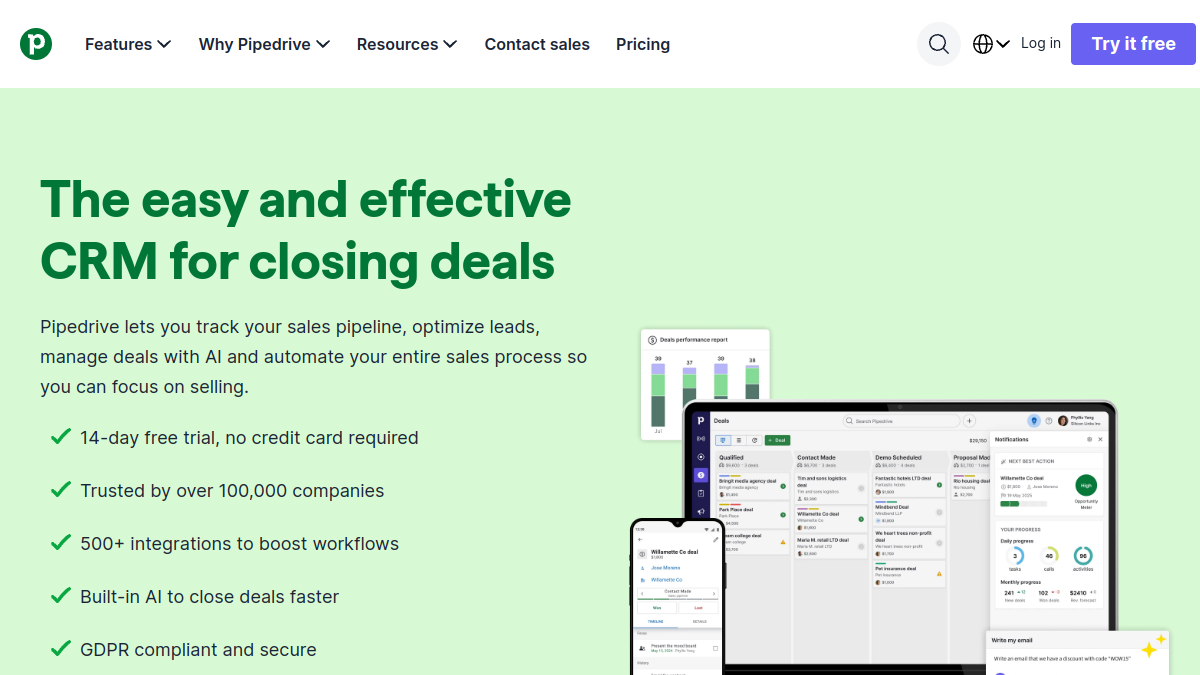
Pipedrive remains the best sales CRM for teams that want pipeline visibility without the administrative overhead of Salesforce. The drag-and-drop deal board is genuinely intuitive—salespeople immediately understand where deals sit and what needs to happen next. Users consistently praise how the visual pipeline reduces meeting friction and keeps teams accountable.

Onboarding is remarkably fast. Most reps are productive within hours, not weeks. The platform ships with solid email integration (two-way sync with Gmail and Outlook), task automation, and reporting that serves 5–15 person teams well. At the Growth plan ($39/user/month annually), Pipedrive represents genuine value for sales-focused organisations that have outgrown free CRM alternatives but aren't ready for enterprise complexity.

7.8/10
RC Score

01 / 06What Pipedrive Does Well: Visual Simplicity at Its Core

Pipedrive remains the best sales CRM for teams that want pipeline visibility without the administrative overhead of Salesforce. The drag-and-drop deal board is genuinely intuitive—salespeople immediately understand where deals sit and what needs to happen next. Users consistently praise how the visual pipeline reduces meeting friction and keeps teams accountable.

Onboarding is remarkably fast. Most reps are productive within hours, not weeks. The platform ships with solid email integration (two-way sync with Gmail and Outlook), task automation, and reporting that serves 5–15 person teams well. At the Growth plan ($39/user/month annually), Pipedrive represents genuine value for sales-focused organisations that have outgrown free CRM alternatives but aren't ready for enterprise complexity.

02 / 06The Pricing Trap: Base Plans Hide Real Costs

Pipedrive's headline pricing ($14–$79 per user/month annually) masks a painful reality: essential workflows live in paid add-ons. LeadBooster (chatbots, prospecting) costs $32.50/month per company. Campaigns (email marketing) adds $13.33/month. Web Visitors (website tracking) runs $41/month. For a 3-person team on the Growth plan ($49/month per user), add-ons can easily double the monthly bill to $300+.

Real customers report median annual contracts of $800 per company based on verified purchases. The platform's tiered support structure exacerbates this: only Premium and Ultimate plans include live chat and phone support, pushing small teams toward higher tiers even when base features suffice. This strategy contradicts Pipedrive's founding promise of simplicity for small businesses.

03 / 06Automation: Where Ambition Meets Limitation

Workflow automation exists, but it's shallow. Basic triggers (deal stage changes) can execute simple actions (send email, create task), but users frequently report frustration with complex branching logic and conditional sequences. Teams needing sophisticated lead nurturing workflows or multi-step approval processes often resort to Zapier integrations, adding cost and friction.

This gap widens when teams grow beyond pure sales into marketing or operations. Pipedrive was explicitly designed for salespeople, not administrators or marketing operations. That focus is a strength for deal-focused teams but a significant limit for organisations outgrowing a single department.

04 / 06Support Quality Varies by Tier

Lowest-plan users receive online help, chatbots, and email support only. Phone support and live chat require Premium ($49/user/month) or higher. This tiered approach frustrates small businesses new to CRM software who need guidance but lack budget for premium tiers. Personalised onboarding is available only for accounts spending $1,000+ monthly.

One verified G2 reviewer in February 2026 praised the interface but gave support a zero out of five. This is not an isolated complaint. Teams scaling Pipedrive repeatedly cite support limitations as a reason to evaluate alternatives like HubSpot or Zoho.

05 / 06Feature Breadth vs. Depth: A Deliberate Trade-Off

Pipedrive includes reporting, forecasting, activity tracking, and AI-powered deal probability estimates via its Sales Assistant. Email templates, custom fields, and multiple pipelines work well. However, advanced lead scoring, behaviour-triggered automation, and complex custom objects are not available. Marketing automation is limited to the Campaigns add-on, which is a basic email marketing tool—not a replacement for HubSpot or ActiveCampaign.

This is intentional. Pipedrive's product strategy targets teams 5–50 people with straightforward, linear sales processes. It explicitly avoids feature bloat. Users praise this focus, but organisations needing deeper customisation quickly encounter ceilings.

06 / 062026 Context: Vista's Influence and Market Position

Since Vista Equity Partners acquired a controlling stake in January 2020 (valuing Pipedrive at $1.5 billion), pricing has increased and the product has drifted toward mid-market buyers. The platform now serves over 100,000 companies with 1,000 employees. G2 ranked Pipedrive #6 in Best Sales Software for 2026 in March. This reputation is well-deserved for its core use case but masks the reality that small bootstrapped startups often feel nickeled-and-dimed by add-on costs.

For 2026 buyers, the key decision is not whether Pipedrive works—it does—but whether your team's needs fit its narrower scope. Teams needing marketing automation, complex custom objects, or enterprise governance should evaluate HubSpot, Salesforce, or Zoho. Teams with defined pipelines and 5–50 salespeople find real productivity and cost-efficiency.

How we researched this

The research basis

What this review is built on. Our research is AI-assisted and draws on vendor documentation and published user feedback rather than our own lab testing — see the methodology page for the limits of that.

Duration
research-based
continuous monitoring
Test count
distinct tests
Testers
contributors
Sponsored?
No
Editorial integrity
What we observed

The honest summary

After every long-form review, we publish the two-sided summary. What proved durable, and what failed during testing.

What held up

4 items
  • +Visual drag-and-drop pipeline interface remains intuitive and reduces deal visibility friction
  • +Fast onboarding and ease of use allow new users to be productive within hours
  • +Email integration with two-way sync and tracking is robust and effective for follow-ups
  • +Per-seat pricing is genuinely affordable for small teams compared with enterprise CRMs

What broke

4 items
  • Add-ons and hidden costs push real total cost of ownership significantly higher than headline pricing
  • Automation depth is limited; complex workflows force teams toward third-party integrations like Zapier
  • Customer support is tiered by plan, leaving lowest-tier users with minimal guidance despite pricing volatility
  • Reporting and marketing capabilities are shallow compared with dedicated analytics or marketing automation platforms
Common questions

What people ask about Pipedrive

Straight answers to what buyers actually ask, drawn from the documentation and published user reports.

Is there a free tier or free trial?
No permanent free plan, but Pipedrive offers a 14-day free trial on all plans with no credit card required. This allows proof-of-concept testing before commitment.
What's the realistic starting point for a 5-person sales team?
The Growth plan ($39/user/month annually, $49 monthly) is the realistic baseline. The Lite plan lacks email sync and automation, which most teams need. For 5 users, Growth costs $195/month annually plus potential add-ons (LeadBooster $32.50, Smart Docs, or Campaigns).
How does Pipedrive compare with HubSpot and Salesforce?
Pipedrive beats HubSpot on pipeline usability and deal-focused workflows; HubSpot wins on native marketing automation and all-in-one go-to-market capability. Salesforce offers deeper customisation and enterprise features but requires longer setup and higher cost. Pipedrive is the winner for small teams prioritising speed and simplicity.
What add-ons are worth purchasing?
LeadBooster (chatbots and prospecting) is valuable for lead-generation-focused teams. Campaigns makes sense if you need email marketing without external tools. Web Visitors helps attribution-conscious teams. Smart Docs (included in Premium+) is useful for document generation. Evaluate based on your specific workflow gaps.
Can I downgrade my plan mid-contract?
Yes. Pipedrive prorates refunds if you downgrade during a billing cycle, crediting the difference to future invoices. This flexibility is helpful if you over-committed to a higher tier.
A
Written by

Admin

Pipedrive Review 2026: Pipeline-First CRM for Small Teams That Values Simplicity Over Complexity · ReviewCost