Otter.ai Review 2026: Strong Transcription for Solo Work, Fragile in Groups
Accurate one-on-one transcription with excellent ease of use, but reduced minute caps, multi-speaker struggles, and privacy litigation undermine its value proposition.
Accurate one-on-one transcription with excellent ease of use, but reduced minute caps, multi-speaker struggles, and privacy litigation undermine its value proposition.

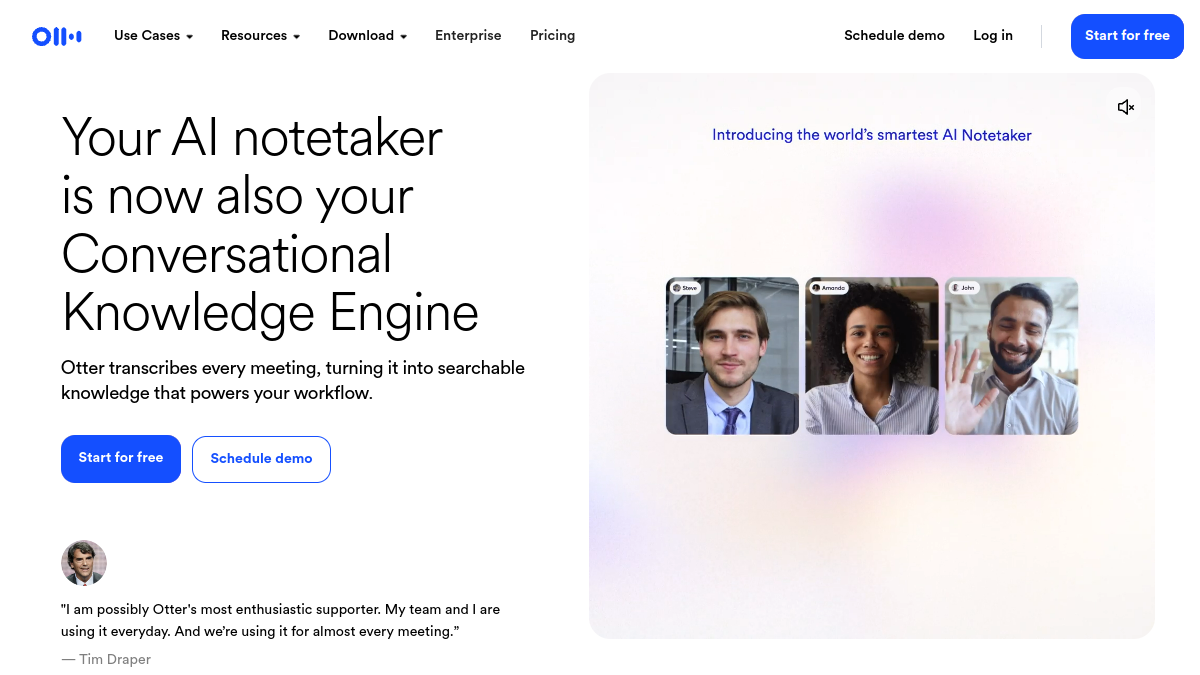
Otter.ai's 2026 pricing appears competitive on the surface: Basic is free at 0/month with 300 minutes, Pro is 8.33/month annual (16.99 monthly) with 1,200 minutes, Business is 19.99/user/month annual (30 monthly) with unlimited meeting transcription, and Enterprise contracts typically range from 15,000 to 35,000 per year.
However, a significant shadow hangs over the Pro tier. Otter reduced the Pro plan from 6,000 minutes to 1,200 per month without lowering the price, a change that was not widely communicated and surprised many existing subscribers. For teams running five or more daily meetings, this cap evaporates within two weeks. Unlike some competitors, Otter doesn't offer pay-as-you-go overage charges; when you hit your monthly limit on Basic or Pro, the service stops working entirely. The Business plan addresses this by removing the minute cap, but at a minimum of five seats, it locks smaller teams into higher spend than they may need.
Otter.ai's 2026 pricing appears competitive on the surface: Basic is free at 0/month with 300 minutes, Pro is 8.33/month annual (16.99 monthly) with 1,200 minutes, Business is 19.99/user/month annual (30 monthly) with unlimited meeting transcription, and Enterprise contracts typically range from 15,000 to 35,000 per year.
However, a significant shadow hangs over the Pro tier. Otter reduced the Pro plan from 6,000 minutes to 1,200 per month without lowering the price, a change that was not widely communicated and surprised many existing subscribers. For teams running five or more daily meetings, this cap evaporates within two weeks. Unlike some competitors, Otter doesn't offer pay-as-you-go overage charges; when you hit your monthly limit on Basic or Pro, the service stops working entirely. The Business plan addresses this by removing the minute cap, but at a minimum of five seats, it locks smaller teams into higher spend than they may need.
Otter's transcription engine performs admirably in controlled environments. Transcription accuracy is solid for standard American English, and Otter identifies when speakers change and labels them; on two-person interviews, accuracy was excellent, and even on multi-speaker Air Force One gaggles, Otter correctly identified most speaker changes. Otter automatically strips 'um,' 'uh,' 'you know' and similar verbal tics, which saves real time for journalists pulling quotes.
The weakness emerges in messy real-world meetings. Users on G2 frequently note that Otter struggles when several people talk at once or when background noise is present, leading to mixed-up segments or incorrect attributions. Non-native accents, technical jargon, and industry-specific terms are where it gets shaky; users in fields like medicine, law, or software engineering frequently mention that proper nouns and acronyms come out wrong unless you manually add them to the custom vocabulary. Some reviewers report that Otter sometimes mislabels speakers or defaults to generic tags like 'Speaker 1' rather than actual names.
Otter is genuinely one of the easier transcription tools to get started with; there's no complex onboarding, and the bot just works once you connect your calendar. Users appreciate its seamless integration with platforms like Google Meet and Zoom, and many highlight its intuitive interface and quick setup process. The AI Chat feature is intuitive; Otter's AI chat lets you interact with your transcripts for seamless navigation and insights.
The bot's intrusiveness, however, creates friction in practice. The bot is intrusive; in practice, people become more guarded, speak less candidly, and conversation flows suffer. Additionally, Otter AI's bot requires stable internet connectivity and proper permissions, which can be problematic in poor network conditions or restricted environments.
Otter currently transcribes conversations in American English, British English, Spanish, and French—only four languages. Otter still trails competitors that offer transcription in dozens or even hundreds of languages, a significant limitation for global teams or organisations working with non-English speakers.
A shadow over 2026 adoption is Otter's legal exposure. Otter AI's security became a major concern following a federal class-action lawsuit filed in August 2025; the case, filed in the U.S. District Court for the Northern District of California, alleges that Otter 'deceptively and surreptitiously' records private conversations without proper consent. Beyond litigation, Otter uses customer files to train its AI models (data is de-identified, but it's used nonetheless); for investigative work with sensitive material, this is worth considering, though you can opt out if you actively choose that setting.
User reviews paint a mixed picture. Students and solo professionals report that Otter improves lecture and interview recaps without distraction, with one Trustpilot reviewer noting it boosts productivity, especially with Otter's AI chat features. However, Reddit users report shrinking value ('you're getting less monthly minutes allowance for what you pay for compared to the past'), note quality falling behind newer tools, and the visible bot, with one r/sales rep writing he doesn't want 'something automatically joining every single Teams call'. Otter does run promotions in exchange for high reviews, making the overall 4.08 score potentially dubious.
What this review is built on. Our research is AI-assisted and draws on vendor documentation and published user feedback rather than our own lab testing — see the methodology page for the limits of that.
After every long-form review, we publish the two-sided summary. What proved durable, and what failed during testing.
Straight answers to what buyers actually ask, drawn from the documentation and published user reports.