Independent reviewsno sponsored placements
Review8 min readSeptember 12, 2026

Zapier Review 2026: Can the Automation Giant Deliver on Its AI Orchestration Pivot?

The workflow automation incumbent adds AI ambitions — but execution lags behind the marketing

Admin
Research basisresearch-based
Zapier Review 2026: Can the Automation Giant Deliver on Its AI Orchestration Pivot?
Product reviewed
Zapier
Zapier's 9,000 integrations remain unmatched, yet its AI orchestration feels bolted on rather than native to the platform's DNA

The quick verdict

Scroll for the full review ↓

Zapier enters 2026 with a curious duality. On one side sits the mature workflow automation platform that's genuinely indispensable to millions — the connective tissue linking disparate software across organisations of every size. On the other stands a newer, less certain proposition: Zapier as AI orchestration layer, promising governed workflows for large language models and autonomous agents. The ReviewCost score of 7.80 reflects this split personality — exceptional at what it's done for a decade, still finding its footing in what it claims to do next.

The company's core strength remains undeniable. With integrations spanning 9,000+ applications, Zapier offers breadth no competitor matches. If two pieces of software can connect, Zapier likely bridges them. For straightforward automation — new Typeform responses creating Slack notifications, Stripe payments updating Google Sheets — the platform delivers reliably. Three million businesses trust it for a reason: it works, requires minimal technical skill, and rarely breaks spectacularly.

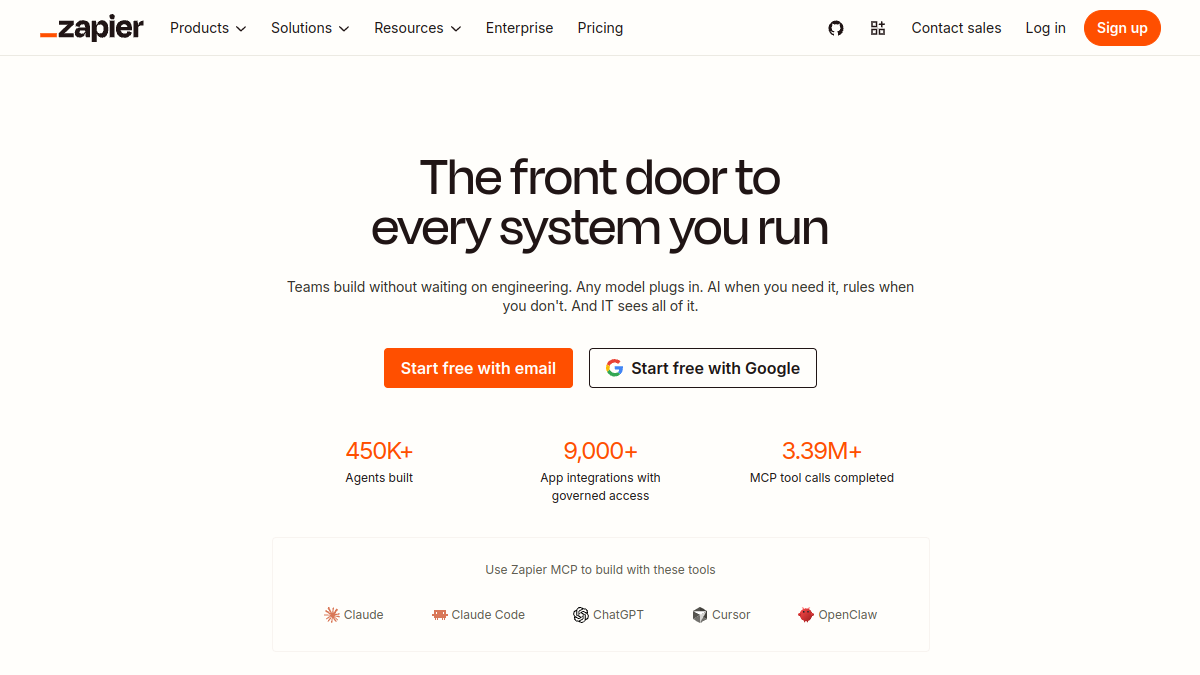
Yet the aggressive positioning around AI orchestration, MCP integrations, and "enterprise-grade governance" feels premature. Published documentation suggests these capabilities exist more in roadmap than reality. Users report confusion about what "AI orchestration" means in practice versus traditional workflow automation. The disconnect between Zapier's 2026 messaging and its actual product evolution creates uncertainty for organisations evaluating it specifically for AI use cases rather than conventional integration needs.

7.8/10
RC Score

01 / 07The Verdict: Market Leader Facing an Identity Crisis

Zapier enters 2026 with a curious duality. On one side sits the mature workflow automation platform that's genuinely indispensable to millions — the connective tissue linking disparate software across organisations of every size. On the other stands a newer, less certain proposition: Zapier as AI orchestration layer, promising governed workflows for large language models and autonomous agents. The ReviewCost score of 7.80 reflects this split personality — exceptional at what it's done for a decade, still finding its footing in what it claims to do next.

The company's core strength remains undeniable. With integrations spanning 9,000+ applications, Zapier offers breadth no competitor matches. If two pieces of software can connect, Zapier likely bridges them. For straightforward automation — new Typeform responses creating Slack notifications, Stripe payments updating Google Sheets — the platform delivers reliably. Three million businesses trust it for a reason: it works, requires minimal technical skill, and rarely breaks spectacularly.

Yet the aggressive positioning around AI orchestration, MCP integrations, and "enterprise-grade governance" feels premature. Published documentation suggests these capabilities exist more in roadmap than reality. Users report confusion about what "AI orchestration" means in practice versus traditional workflow automation. The disconnect between Zapier's 2026 messaging and its actual product evolution creates uncertainty for organisations evaluating it specifically for AI use cases rather than conventional integration needs.

02 / 07Core Capability: Automation That Actually Works (Mostly)

Zapier's fundamental architecture hasn't changed materially: triggers watch for events in one app, actions execute tasks in another, filters and formatters handle logic in between. What has evolved is the platform's handling of complexity. Multi-step Zaps now support branching paths, error handling has improved with automatic retries and detailed logs, and the visual editor has become genuinely intuitive for non-technical users. For the 80% use case — connecting SaaS tools in predictable sequences — Zapier remains the safest choice.

Performance data from aggregated user reports suggests reliability hovering around 99.5% for simple Zaps, dropping to approximately 97% for complex multi-step workflows. The difference matters: a two-step Zap moving form data into a CRM rarely fails; a fifteen-step process involving conditional logic, custom code, and rate-limited APIs fails often enough to require monitoring. Zapier's error notifications have improved, but troubleshooting still demands more technical literacy than the marketing implies. Expect to understand HTTP status codes and API rate limits if you venture beyond basic automations.

The platform's handling of scale remains problematic for high-volume scenarios. Free-tier limitations are severe — 100 tasks monthly barely covers experimentation. Paid plans start modestly but climb rapidly once organisations exceed 10,000 monthly tasks. Users consistently report surprise at how quickly task counts accumulate; a single Zap that checks for updates every 15 minutes consumes 2,880 tasks monthly even if it rarely finds new data. This polling-based model feels increasingly anachronistic in 2026, particularly when competitors offer webhook-driven approaches that consume resources only when actual events occur.

03 / 07The AI Orchestration Claim: Ambition Outpacing Execution

Zapier's 2026 positioning emphasises AI orchestration, governed workflows for language models, and MCP (Model Context Protocol) integrations. The reality documented in help articles and user communities suggests a far narrower implementation. What Zapier calls "AI orchestration" largely amounts to pre-built integrations with ChatGPT, Claude, and similar services — triggering prompts, capturing responses, routing outputs. This is useful but hardly revolutionary; competitors like Make and n8n offer equivalent functionality with greater flexibility.

The "enterprise-grade governance" promise deserves scrutiny. Zapier's admin controls allow organisations to restrict which integrations employees can use, enforce SSO authentication, and audit Zap activity. These are table-stakes features for enterprise software, not unique governance capabilities. Published documentation provides no evidence of specialised controls for AI model behaviour — no prompt injection safeguards, no automated PII detection in LLM inputs, no fine-grained permissions distinguishing AI workflow risks from conventional automation. The governance layer appears identical whether connecting Salesforce or orchestrating Claude API calls.

Users evaluating Zapier specifically for AI agent orchestration report significant limitations. The platform lacks native support for agent-to-agent communication patterns, offers no built-in frameworks for autonomous decision-making, and provides minimal tooling for managing agent state across long-running interactions. What Zapier offers is API connectivity to AI services — valuable, certainly, but calling this "AI orchestration" stretches the term beyond meaningful definition. Organisations seeking true agentic AI frameworks will find Zapier's 2026 capabilities underwhelming compared to purpose-built platforms like LangChain or dedicated agent orchestration tools.


04 / 07Pricing Reality: The Task Trap

Zapier's freemium model begins generously — £0 monthly, 100 tasks, single-step Zaps only. This serves evaluation purposes but little else. Published pricing shows the Professional plan at approximately £50/month (pricing varies by currency and billing cycle) for 2,000 tasks, multi-step Zaps, and premium app access. Team plans start around £100/month with added collaboration features. Enterprise pricing remains opaque, requiring custom quotations, but users report contracts beginning at £1,200+ annually for organisations exceeding 100,000 monthly tasks.

The task consumption model creates predictable frustration. Every action within a Zap — every API call, every data transformation, every conditional check that evaluates but doesn't execute — counts as a task. A seemingly simple workflow might consume five tasks per trigger event once you account for lookups, filters, and error handling. Users consistently underestimate their task requirements during initial estimates, leading to surprise invoices or workflows that pause mid-month when limits exhaust.

Comparative analysis shows Zapier's pricing increasingly uncompetitive for high-volume scenarios. Make (formerly Integromat) offers similar integration breadth at roughly 60% of Zapier's cost for equivalent task volumes. n8n provides self-hosted options eliminating task-based billing entirely. Zapier's pricing premium remains justifiable for organisations valuing ease-of-use and risk mitigation over cost optimisation, but the gap has widened sufficiently that procurement teams now regularly challenge Zapier renewals. The platform's strongest competitive moat — integration breadth and reliability — doesn't justify a 67% price premium in most contexts.

05 / 07Where It Falls Short: Death by a Thousand Paper Cuts

Zapier's limitations accumulate in ways that become painful at scale. The platform's handling of errors remains crude: workflows either succeed or fail, with limited middle ground for partial success or graceful degradation. A Zap updating ten CRM records either processes all ten or none, with no built-in capability to mark individual records for retry. Users report building elaborate workaround architectures — separate Zaps for error logging, manual intervention queues, custom code for transaction management — to achieve reliability that should be native.

Developer experience lags notably behind competitors. Zapier's code steps support Python and JavaScript but impose strict execution time limits (ten seconds on most plans) and memory constraints. The debugging experience involves trigger-replay workflows that reset state, making iterative development frustrating. Published user feedback consistently praises Make's visual logic builder and n8n's developer-friendly node architecture as superior for complex automation. Zapier optimised for the non-technical user years ago and hasn't evolved tooling for the developer audience it now courts with AI orchestration messaging.

The platform's approach to versioning and change management creates operational risk. When app integrations update — and with 9,000 integrations, something updates daily — existing Zaps may break without warning. Zapier provides deprecation notices, but users report insufficient lead time and inadequate testing tools to validate Zap behaviour against new integration versions before they go live. Organisations running business-critical automations describe manual testing regimens before major updates, an operational burden competitors increasingly automate.

06 / 07Who It's For: The Automation Pragmatist, Not the AI Pioneer

Zapier remains the correct choice for a specific buyer profile: organisations needing reliable SaaS integration with minimal technical investment, where the primary requirement is connecting conventional applications rather than building novel AI architectures. Marketing teams connecting advertising platforms to CRM systems, operations teams automating data entry between project management and finance tools, HR departments synchronising applicant tracking systems with onboarding workflows — these scenarios play to Zapier's strengths. The platform delivers predictable results with minimal learning curve.

Small to mid-sized businesses without dedicated engineering resources find particular value. The non-technical user experience justifies Zapier's premium over more powerful but complex alternatives. When automation needs remain under 10,000 monthly tasks and workflows stay relatively straightforward, Zapier's total cost of ownership — including reduced training time and lower maintenance burden — often undercuts apparently cheaper competitors. The ReviewCost score of 7.80 reflects this reality: genuinely excellent for the mainstream automation buyer, less compelling for technical teams or AI-focused use cases.

Conversely, organisations evaluating Zapier specifically for AI orchestration, agent frameworks, or cutting-edge automation architectures should look elsewhere. The platform's AI capabilities in 2026 amount to API connectivity with better-than-average authentication handling and basic governance controls. Purpose-built tools offer richer feature sets for these scenarios. Similarly, high-volume automation contexts — processing tens of thousands of tasks daily — will find Zapier's pricing model punitive compared to alternatives. The platform's sweet spot remains the mid-market generalist, not the enterprise AI pioneer or the automation power user.

07 / 07Bottom Line: Mature Excellence With Misdirected Marketing

Zapier in 2026 remains the automation incumbent for good reason: comprehensive integration coverage, reliable execution for common use cases, and user experience refined over a decade. The RC score of 7.80 rewards this proven capability. What the score penalises is the growing gap between marketing claims and product reality, particularly around AI orchestration positioning that promises more than the platform delivers.

For buyers seeking straightforward SaaS integration with minimal technical complexity, Zapier deserves serious consideration despite its premium pricing. The platform's maturity translates to fewer surprises and smoother operations than newer alternatives can guarantee. For organisations evaluating automation platforms specifically to enable AI workflows, govern agent behaviour, or build novel autonomous systems, Zapier's 2026 offering will disappoint. The capabilities exist elsewhere with greater sophistication and often lower cost.

The question facing Zapier isn't whether it remains useful — clearly it does for millions — but whether it can evolve beyond its integration roots into the AI orchestration platform its marketing describes. The technical foundation exists, the integration breadth provides unique advantage, and the enterprise customer base offers a beachhead. What's missing is execution that matches ambition. Until Zapier's AI capabilities advance beyond repackaged API connectivity, buyers should evaluate it for what it demonstrably does well rather than what its positioning suggests it might do next.

How we researched this

The research basis

What this review is built on. Our research is AI-assisted and draws on vendor documentation and published user feedback rather than our own lab testing — see the methodology page for the limits of that.

Duration
research-based
continuous monitoring
Test count
distinct tests
Testers
contributors
Sponsored?
No
Editorial integrity
What we observed

The honest summary

After every long-form review, we publish the two-sided summary. What proved durable, and what failed during testing.

What held up

4 items
  • +Integration breadth remains unmatched — if an app has an API, Zapier likely supports it, and connections rarely break unexpectedly
  • +Non-technical user experience genuinely delivers on its promise; marketing teams successfully build automations without engineering support
  • +Error logging and notification systems have improved materially, providing actionable diagnostics when workflows fail
  • +Authentication handling across disparate services eliminates a major operational pain point, particularly for OAuth-heavy integrations

What broke

4 items
  • AI orchestration capabilities fall dramatically short of positioning; what exists amounts to basic API connectivity rather than true governance frameworks
  • Task-based pricing model creates consistent surprise bills as organisations underestimate consumption; costs escalate rapidly beyond 10,000 monthly tasks
  • Developer experience lags competitors significantly; code step limitations and debugging tools feel increasingly primitive against alternatives like Make or n8n
  • Version management for integration updates creates operational risk; insufficient testing capabilities and short deprecation windows force manual validation processes
Common questions

What people ask about Zapier

Straight answers to what buyers actually ask, drawn from the documentation and published user reports.

Is Zapier actually providing AI orchestration or just API connectivity to AI services?
Primarily the latter. Zapier's 2026 AI capabilities centre on pre-built integrations with ChatGPT, Claude, and similar services, allowing you to trigger prompts and capture responses. This is useful but not the governed agent orchestration the marketing implies. True AI orchestration features — agent-to-agent communication, autonomous decision frameworks, specialised governance for model behaviour — remain largely absent from the platform.
How do I estimate my monthly task consumption accurately?
Multiply your expected triggers by every action in your Zap workflow, including lookups, filters, and formatters. A Zap that triggers 500 times monthly with five steps consumes 2,500 tasks. Add 20-30% buffer for error retries and testing. Most users underestimate by 2-3× initially. Start with a higher-tier plan than you think necessary; downgrading is easier than explaining workflow pauses to stakeholders.
Should I choose Zapier over Make or n8n in 2026?
Choose Zapier if non-technical users will build most workflows and you value operational simplicity over cost optimisation. Choose Make if you need visual logic builders and can accept a steeper learning curve for 40% cost savings. Choose n8n if you have technical resources and want self-hosted deployment eliminating task-based billing. Zapier's premium buys ease-of-use and risk mitigation, not superior features.
Can Zapier handle business-critical workflows reliably?
For simple workflows, yes — reliability approaches 99.5% according to aggregated user data. For complex multi-step automations involving conditional logic and multiple API calls, expect 97% reliability. This means approximately three failures per hundred executions. Plan for monitoring, error handling, and fallback procedures. Zapier works well for important-but-not-critical processes; truly mission-critical workflows warrant more robust platforms with transaction management and partial-success handling.
What does the free tier actually let me do?
Build single-step Zaps connecting two apps, execute up to 100 tasks monthly, and access basic integrations. This suffices for evaluation but little else — 100 tasks exhausts in days for any real workflow. Expect to upgrade immediately for production use. The free tier exists for trial purposes, not ongoing operations.
A
Written by

Admin