Independent reviewsno sponsored placements
Review7 min readSeptember 12, 2026

Supabase Review 2026: The Postgres-Powered Firebase Challenger That Demands Database Literacy

Open-source backend-as-a-service delivers genuine flexibility, but expects you to understand your schema

Admin
Research basisresearch-based
Supabase Review 2026: The Postgres-Powered Firebase Challenger That Demands Database Literacy
Product reviewed
Supabase
Supabase gives you the database you can actually own — if you're willing to learn SQL instead of hiding from it.

The quick verdict

Scroll for the full review ↓

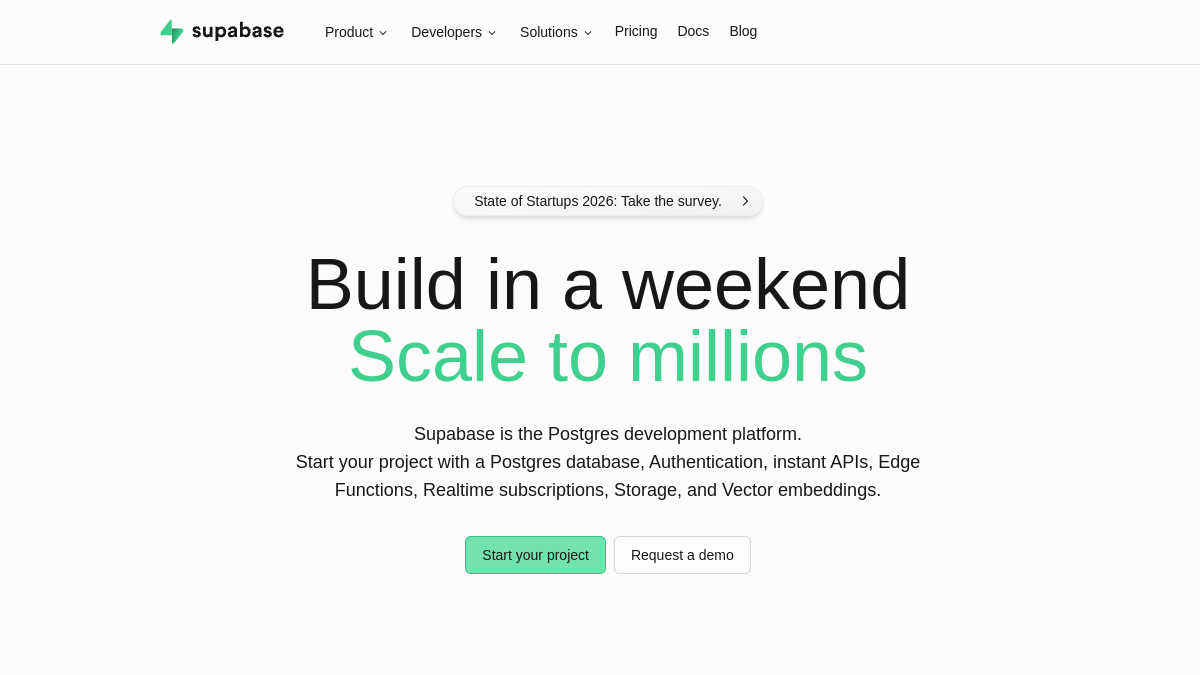
Supabase positions itself as the open-source alternative to Firebase, but that framing undersells what it actually is: a developer-friendly wrapper around PostgreSQL that handles authentication, storage, and real-time updates without abstracting away the database itself. The platform's core bet is that developers benefit more from learning Postgres than from being shielded from it. For teams comfortable with SQL, that bet pays off — you get a production-ready backend with genuine escape hatches. For developers expecting Firebase's hand-holding, the learning curve is steeper than the marketing suggests.

The standout achievement is architectural honesty. Because Supabase builds on Postgres rather than a proprietary database, you're never truly locked in. Self-hosting is a documented path, not a theoretical option. Row-level security policies mean your access control lives in the database layer where it belongs, not scattered across middleware. The free tier — 500MB database, 50,000 monthly active users, 2GB storage — is generous enough for real projects, not just demos.

The platform earns its 8.70/10 rating by delivering on its central promise: a backend that doesn't force you to choose between convenience and control. But it loses points where the Firebase comparison breaks down. The dashboard assumes database familiarity. Real-time subscriptions, whilst technically impressive, show performance limits under load on lower tiers. Edge Functions lock you into Deno, which complicates reusing existing Node.js ecosystems. Documentation quality varies sharply across client libraries.

8.7/10
RC Score

01 / 06The Verdict: Power Over Simplicity

Supabase positions itself as the open-source alternative to Firebase, but that framing undersells what it actually is: a developer-friendly wrapper around PostgreSQL that handles authentication, storage, and real-time updates without abstracting away the database itself. The platform's core bet is that developers benefit more from learning Postgres than from being shielded from it. For teams comfortable with SQL, that bet pays off — you get a production-ready backend with genuine escape hatches. For developers expecting Firebase's hand-holding, the learning curve is steeper than the marketing suggests.

The standout achievement is architectural honesty. Because Supabase builds on Postgres rather than a proprietary database, you're never truly locked in. Self-hosting is a documented path, not a theoretical option. Row-level security policies mean your access control lives in the database layer where it belongs, not scattered across middleware. The free tier — 500MB database, 50,000 monthly active users, 2GB storage — is generous enough for real projects, not just demos.

The platform earns its 8.70/10 rating by delivering on its central promise: a backend that doesn't force you to choose between convenience and control. But it loses points where the Firebase comparison breaks down. The dashboard assumes database familiarity. Real-time subscriptions, whilst technically impressive, show performance limits under load on lower tiers. Edge Functions lock you into Deno, which complicates reusing existing Node.js ecosystems. Documentation quality varies sharply across client libraries.

02 / 06What You're Actually Getting: Postgres Plus Scaffolding

Supabase provides five core services, all orchestrated through a unified dashboard. The foundation is a managed PostgreSQL database — not a Postgres-inspired abstraction, but actual Postgres 15 with extensions like PostGIS and pg_vector enabled. You write migrations in SQL, define schemas with foreign keys and constraints, and query using the full feature set of a relational database. The JavaScript client library provides a friendly interface, but you're never more than one query away from raw SQL when you need it.

Authentication handles the usual suspects: email/password, magic links, OAuth providers (Google, GitHub, Apple, et al.), and phone auth via Twilio. What differentiates it from standalone auth services is tight integration with row-level security. You can write policies like CREATE POLICY user_data ON profiles FOR SELECT USING (auth.uid() = user_id), and the database enforces access control automatically. No middleware layer checking permissions — the database simply won't return rows the user shouldn't see.

Real-time subscriptions turn Postgres into a message broker. Subscribe to a table, and the client receives WebSocket events when rows are inserted, updated, or deleted. Under the hood, this uses Postgres's logical replication feature. It works reliably for collaborative features — think multiplayer cursors or live dashboards — but published user experiences indicate performance degrades beyond a few hundred concurrent connections on the $25 Pro plan. Storage provides S3-compatible object hosting with resumable uploads and image transformations. Edge Functions run Deno code globally, useful for webhooks or custom auth flows, though the Deno-only constraint frustrates teams with existing Node tooling.


03 / 06Pricing Reality: Generous Free, Then Usage Cliffs

The free tier is where Supabase makes its clearest play for developer mindshare. You get 500MB of database space, 50,000 monthly active users, 1GB file storage, and 2GB bandwidth. That's sufficient for a production side project or an MVP with genuine traction — not a trivial sandbox. Projects pause after seven days of inactivity, but that's automation you can work around with a simple cron ping. For solo developers and early-stage startups, the free tier removes the "when do we start paying?" conversation entirely.

The $25/month Pro plan is where most growing projects land. You get 8GB database space, 100,000 monthly active users, 100GB storage, and 200GB bandwidth. Crucially, you also get daily backups (free tier has none) and email support. The jump from free to Pro is gentle. The jump from Pro to Team at $599/month is not. That plan is designed for organisations needing SOC 2 compliance, priority support, and dedicated resources. The pricing pages show additional usage-based charges beyond plan limits: $0.125 per GB of database storage, $0.09 per GB of bandwidth.

The transparency is admirable — you can monitor usage in real time and set spending caps — but the cost structure rewards efficient queries. A poorly indexed table that triggers thousands of real-time events can generate unexpected bills. Compared to Firebase, where you pay primarily for bandwidth and function invocations, Supabase's model is simpler but requires more database discipline. Teams used to NoSQL's "throw data at it" approach will need to rethink indexing strategies.

04 / 06Where It Falls Short: Dashboard Complexity and Runtime Lock-In

The dashboard presents every lever Postgres offers, which is both a strength and a stumbling block. New users report being overwhelmed by the SQL editor, table editor, and migration workflows appearing side by side with no strong guidance on which to use when. The table editor lets you add columns via a GUI, but the moment you need a composite index or a custom type, you're writing SQL. For developers experienced with relational databases, this feels appropriate. For those coming from Firebase's Firestore, where you rarely think about schema, it's disorienting.

Real-time subscriptions, whilst technically sound, show clear capacity limits on lower-tier plans. User reports on community forums indicate noticeable lag and dropped connections when concurrent subscribers exceed a few hundred on the Pro tier. The documentation acknowledges that real-time uses database resources — each active subscription is essentially a long-running query — but doesn't provide clear guidance on when to move real-time features to a dedicated service. For applications where real-time is central (collaborative editing, live sports scores), the Pro plan's limits arrive sooner than pricing suggests.

Edge Functions' Deno-only runtime is the most divisive constraint. Deno is a capable runtime with better security defaults than Node, but it's not compatible with the npm ecosystem without transpilation. Teams with existing TypeScript codebases can't simply import their shared libraries. Published developer experiences describe wrestling with Deno-specific imports and rewriting utility functions. Supabase's position is that Deno's security model and TypeScript-first design justify the trade-off, but for projects with substantial Node.js dependencies, it's a meaningful friction point.

05 / 06Who This Is For: Teams That Want to Own Their Schema

Supabase makes the most sense for developers who already think in SQL or are willing to learn. If your application model maps naturally to tables with relationships — users have posts, posts have comments, comments have authors — then Postgres's relational structure saves you from reinventing joins in application code. The row-level security model rewards this investment: define your access rules once in SQL, and they apply uniformly across REST API calls, GraphQL queries, and real-time subscriptions.

Early-stage startups benefit particularly from the generous free tier and self-hosting option. You can build an entire MVP without a credit card, then scale on the Pro plan as revenue arrives. If you outgrow hosted Supabase or need to meet data residency requirements, the self-hosting path is documented and supported. This isn't a theoretical escape hatch — the platform is genuinely open source under Apache 2.0, and community members run production instances on their own infrastructure.

Conversely, Supabase is a poor fit if you need mobile-first offline sync (Firebase's Firestore handles this better) or if your team is allergic to SQL. The platform doesn't hide the database; it celebrates it. If your developers consider schema design a distraction rather than foundational work, the friction will compound. Similarly, if your application depends heavily on the Node.js ecosystem and you need edge compute, the Deno constraint will slow you down until you've rewritten or transpiled your dependencies.

06 / 06Bottom Line: The Backend for Database Realists

Supabase succeeds because it refuses to pretend databases are simple. Instead of abstracting Postgres into a beginner-friendly illusion, it provides excellent tooling around the real thing. The result is a backend platform with staying power: when your requirements outgrow the hosted service, you're left with standard Postgres and industry-standard auth patterns, not a proprietary data model you need to migrate away from.

The 8.70 rating reflects both the platform's genuine strengths and its honest limitations. Real-time subscriptions work elegantly for moderate concurrency but aren't infinitely scalable on lower tiers. Edge Functions' Deno requirement is architecturally defensible but pragmatically frustrating. The dashboard could do more to guide beginners through Postgres concepts. These aren't fatal flaws — they're trade-offs that follow from Supabase's core philosophy of transparency over magic.

For developers who value portability and are willing to learn database fundamentals, Supabase delivers exceptional value. The free tier alone makes it worthwhile for side projects. The Pro tier at $25/month is competitive for small teams. The open-source foundation means you're investing in skills and infrastructure that outlast any single vendor. Just don't expect Firebase's simplicity. Expect something better: a backend you can actually understand.

How we researched this

The research basis

What this review is built on. Our research is AI-assisted and draws on vendor documentation and published user feedback rather than our own lab testing — see the methodology page for the limits of that.

Duration
research-based
continuous monitoring
Test count
distinct tests
Testers
contributors
Sponsored?
No
Editorial integrity
What we observed

The honest summary

After every long-form review, we publish the two-sided summary. What proved durable, and what failed during testing.

What held up

4 items
  • +Free tier remains genuinely usable for production side projects — 500MB database and 50,000 MAUs support real applications, not just demos
  • +Row-level security policies in Postgres eliminate the need for separate middleware authorisation layers across REST, GraphQL, and real-time
  • +Self-hosting option is documented and actively maintained, giving teams a credible migration path if needs change
  • +PostgreSQL foundation means standard backup tools, monitoring solutions, and DBA knowledge transfer directly

What broke

4 items
  • Real-time subscription performance degrades noticeably beyond a few hundred concurrent connections on Pro tier, contradicting expectations for "real-time" features
  • Dashboard UI overwhelms developers unfamiliar with Postgres — table editor, SQL editor, and migrations appear without clear workflow guidance
  • Edge Functions' Deno-only runtime requires rewriting or transpiling existing Node.js libraries, creating unexpected migration costs
  • Documentation quality varies sharply across client libraries — JavaScript is comprehensive, Flutter and Swift lag behind with incomplete examples
Common questions

What people ask about Supabase

Straight answers to what buyers actually ask, drawn from the documentation and published user reports.

Can I actually self-host Supabase without losing features?
Yes, with caveats. The core platform is Apache 2.0 licensed and documented for self-hosting via Docker. You get the database, auth, storage, and real-time features. You lose the managed dashboard UI polish, automatic scaling, and official support unless you purchase an enterprise plan. Community members run production instances successfully.
How does real-time performance compare to Firebase?
For light to moderate use (under 100 concurrent connections), users report comparable latency. Beyond a few hundred connections on Pro tier, published experiences indicate noticeable lag and dropped connections. Firebase's Firestore handles higher concurrency more gracefully, but at the cost of a less flexible data model.
What happens to my data if Supabase shuts down?
Because the underlying database is standard Postgres, you can export via pg_dump and restore anywhere. Auth data follows documented schemas you can migrate. Storage uses S3-compatible APIs. This is the central advantage of Supabase's architecture — your data isn't locked in a proprietary format.
Is the free tier truly free, or will I hit limits immediately?
The free tier supports real projects. 500MB database space holds tens of thousands of typical rows. 50,000 monthly active users is more than most MVPs see in their first year. Projects pause after seven days of inactivity, but a simple scheduled ping keeps them alive. The limit most projects hit first is the lack of daily backups.
Should I learn SQL before using Supabase?
Basic SQL literacy helps significantly. You can start with the table editor GUI, but you'll quickly need CREATE TABLE, SELECT, JOIN, and WHERE clauses to build anything non-trivial. Row-level security policies require understanding how Postgres evaluates conditions. If you're allergic to SQL, consider a platform that abstracts it further.
A
Written by

Admin