Independent reviewsno sponsored placements
Review3 min readSeptember 13, 2026

PureVPN Review 2026: Feature-Rich but Pricing Tactics Undermine Value

Strong privacy credentials and global reach offset by inconsistent streaming and aggressive upselling.

Admin
Research basisresearch-based
PureVPN Review 2026: Feature-Rich but Pricing Tactics Undermine Value
Product reviewed
PureVPN
Affordable on paper but renewal pricing doubles; strong privacy audits don't guarantee consistent performance.

The quick verdict

Scroll for the full review ↓

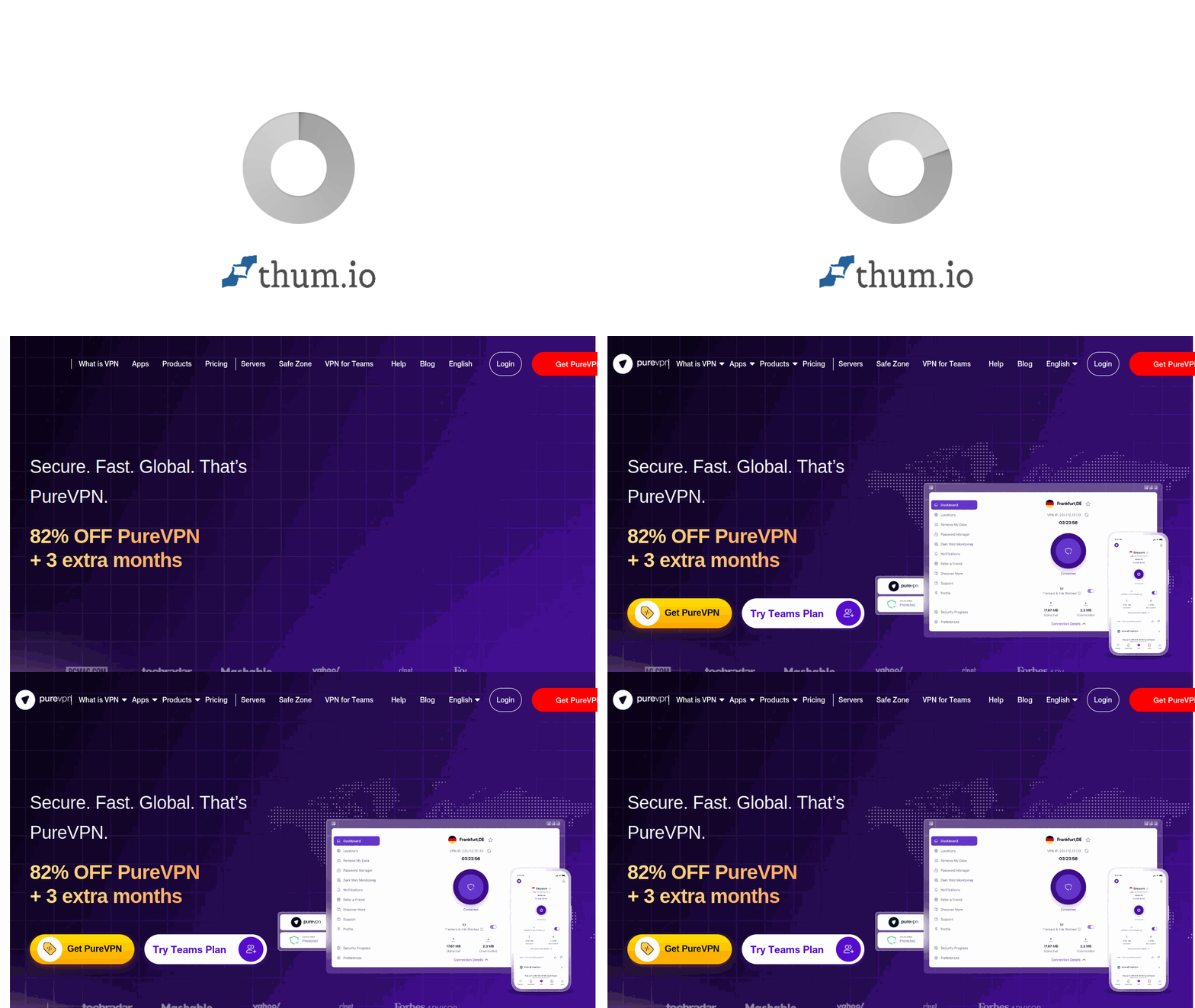
PureVPN's pricing structure warrants careful scrutiny. The advertised rates—$12.95/month for Standard, $15.95 for Plus, and $19.95 for Max—apply only to the initial subscription period. Users report that renewal pricing nearly doubles these figures, a common tactic in the VPN market that can frustrate long-term subscribers.

The service offers three tiers: Standard includes basic VPN with built-in tracker and ad blocking; Plus adds the PureKeep password manager; Max includes data removal tools and dark web monitoring. Annual billing provides marginal savings, with Standard at $57.95/year versus $47.95 for longer commitments. Optional features like port forwarding cost an additional $1.49/month, pushing total costs higher for users wanting full functionality.

7.1/10
RC Score

01 / 06Pricing Strategy: Introductory Bait with Renewal Shock

PureVPN's pricing structure warrants careful scrutiny. The advertised rates—$12.95/month for Standard, $15.95 for Plus, and $19.95 for Max—apply only to the initial subscription period. Users report that renewal pricing nearly doubles these figures, a common tactic in the VPN market that can frustrate long-term subscribers.

The service offers three tiers: Standard includes basic VPN with built-in tracker and ad blocking; Plus adds the PureKeep password manager; Max includes data removal tools and dark web monitoring. Annual billing provides marginal savings, with Standard at $57.95/year versus $47.95 for longer commitments. Optional features like port forwarding cost an additional $1.49/month, pushing total costs higher for users wanting full functionality.

02 / 06Feature Depth: Breadth Over Refinement

PureVPN boasts an impressive feature catalogue that appeals to both casual users and power users. The service supports up to 10 simultaneous connections—beating many premium competitors. Encryption uses AES-256, supplemented by quantum-resistant keys developed in collaboration with Quantinuum. Protocol options include WireGuard, OpenVPN (TCP/UDP), and IKEv2.

However, feature availability varies by protocol. Split tunneling, one of PureVPN's marquee features, is disabled when using WireGuard—the fastest and most secure protocol available. This limitation frustrates users seeking granular control, and independent reviewers flag it as unusual among mainstream VPN providers. The service's 6,000+ servers across 65+ countries provide solid global coverage, though recent reviews note servers are being reorganised into virtual locations.

03 / 06Privacy Claims vs. Execution: Audit Trail but Not Spotless

PureVPN's privacy posture has evolved significantly. The service relocated its legal jurisdiction to the British Virgin Islands in 2021 and now publishes no-log audits conducted by independent firms. ISO 27001 certification and VPN Trust Seal accreditation add transparency signals.

Yet the company's history complicates trust. In 2017, PureVPN was caught providing user logs to the FBI whilst marketing itself as a no-logs service—a incident that remains relevant to privacy-conscious users. Current documentation emphasises repeated audits and compliance certifications as remediation, but the past shadows current claims. Reviewers suggest that existing privacy foundation is reasonable for everyday users, though those demanding maximum assurance should look elsewhere.

04 / 06Streaming and Performance: Inconsistent Results

Streaming capability has been a contentious point across 2026 reviews. Users report hit-or-miss unblocking of Netflix and other geo-restricted platforms. Some PureVPN servers designated for streaming work reliably; others don't. Speed testing shows mixed results: OpenVPN UDP connections exhibit low download speed drop-offs in many locations, but US and UK servers show notable fluctuation. Canadian servers performed more consistently.

Speed with obfuscation—available for users in censored regions—comes at a performance cost, with one reviewer noting it's unsuitable for those prioritising connection speed. Windows users particularly report significant lag and latency issues when running the app, suggesting platform-specific optimisation problems that compound performance concerns.

05 / 06User Experience: Easy to Start, Frustration at Scale

PureVPN's interface earns consistent praise for simplicity. One-click connection, intuitive settings, and cross-platform consistency make initial setup friction-free. Apps are available for Windows, macOS, iOS, Android, Linux, routers, and smart TVs. Browser extensions for Chrome and Firefox provide lightweight quick access.

However, the experience deteriorates for users wanting advanced configuration. The interface masks complexity rather than addressing it. Windows app performance lags reported by multiple sources suggests optimisation remains incomplete. Customer support responsiveness varies, with some reviewers noting mixed quality and others praising dedicated support for team deployments.

06 / 06Verdict: Budget Option with Caveats

PureVPN positions itself as an affordable entry point to VPN services, and the initial pricing justifies that claim. For casual users prioritising simplicity, global unblocking attempts, and privacy basics—without high performance demands—it delivers reasonable value. Strong audit history and compliance certifications provide privacy assurance exceeding the company's 2017 reputation.

Serious reservations arise around renewal pricing shock, inconsistent streaming, Windows performance issues, and feature limitations tied to certain protocols. Users seeking consistent high-speed streaming, or those wanting maximum protocol flexibility, will find competing services more reliable. PureVPN makes sense as an introductory VPN or for users unconcerned about renewal cost escalation, but not for long-term commitment requiring predictable pricing and performance consistency.

How we researched this

The research basis

What this review is built on. Our research is AI-assisted and draws on vendor documentation and published user feedback rather than our own lab testing — see the methodology page for the limits of that.

Duration
research-based
continuous monitoring
Test count
distinct tests
Testers
contributors
Sponsored?
No
Editorial integrity
What we observed

The honest summary

After every long-form review, we publish the two-sided summary. What proved durable, and what failed during testing.

What held up

4 items
  • +Global server network scale (6,000+ servers across 65+ countries) enabling reliable geo-unblocking in most regions
  • +Privacy audit trail with multiple independent no-logs assessments and ISO 27001 certification providing verifiable trust signals
  • +User-friendly interface and cross-platform app consistency making VPN adoption friction-free for beginners
  • +Support for 10 simultaneous connections surpassing typical competitor limits

What broke

4 items
  • Renewal pricing escalation that nearly doubles introductory rates, frustrating long-term subscribers
  • Inconsistent streaming performance with servers either working reliably or failing to unblock content unpredictably
  • Windows app performance issues including significant lag reported across multiple 2026 reviews
  • Split tunneling unavailable on WireGuard protocol, limiting user control despite it being the fastest option
Common questions

What people ask about PureVPN

Straight answers to what buyers actually ask, drawn from the documentation and published user reports.

Why does PureVPN's renewal price jump so high?
Introductory rates (e.g. $12.95/month for Standard) apply only to the initial subscription term. Upon renewal, pricing increases substantially—sometimes doubling—to the standard published rates. This is common in VPN marketing but worth verifying before committing to a long-term subscription.
Is PureVPN's no-logs claim trustworthy after the 2017 FBI incident?
PureVPN relocated to the British Virgin Islands in 2021 and now publishes independent no-logs audits and holds ISO 27001 certification. These improvements provide stronger trust signals, but the 2017 incident remains relevant context. Users demanding maximum assurance may prefer providers with longer clean histories.
Why is split tunneling disabled on WireGuard?
PureVPN restricts split tunneling to OpenVPN and IKEv2 protocols. WireGuard is faster and more secure but doesn't support this granular control feature. Users needing split tunneling must choose a different protocol at the cost of speed.
Will PureVPN unblock Netflix?
It's inconsistent. Some servers designated for streaming work reliably; others fail to bypass geo-restrictions. Users report hit-or-miss success. If streaming is a primary use case, test with PureVPN's money-back guarantee before committing.
A
Written by

Admin

PureVPN Review 2026: Feature-Rich but Pricing Tactics Undermine Value · ReviewCost