Grammarly 2026: Still the Top AI Writing Assistant, If You Can Stomach the Pricing
Powerful generative AI and frictionless integration justify Pro cost for daily writers, but aggressive billing practices undermine trust.

Powerful generative AI and frictionless integration justify Pro cost for daily writers, but aggressive billing practices undermine trust.

Grammarly has matured substantially since 2009. What began as a grammar checker has evolved into a generative AI writing partner, now ranking 4.7/5 on G2 with nearly 13,000 reviews as of Winter 2026. The shift is unmistakable: Grammarly's AI rewriting tools, tone detector, and 2,000 monthly prompts (Pro tier) now compete directly with ChatGPT for everyday business writing. Users report using it to draft emails, refine technical documentation, and maintain professional tone across diverse communication channels. The free plan ($0) provides meaningful value—real-time detection across 400+ rule types, basic tone feedback, and 100 AI prompts—making it genuinely sufficient for students and casual writers. The real payoff lies in Pro.
At $12/month billed annually ($144/year), Pro integrates across 1 million+ apps and sites, from Gmail and Outlook to Slack, Asana, and custom integrations. Users highlight seamless workflow integration as a genuine strength; suggestions appear inline without tab-switching. Trustpilot rates the product 4.5/5. Non-fluent English speakers and professionals working across languages consistently praise Grammarly for reducing editing time and building writing confidence. One physiotherapist noted it cut clinical documentation time whilst maintaining clarity—a high-stakes use case. For daily writers, the ROI is evident: $144/year often pays for itself in recovered editing hours.
Grammarly has matured substantially since 2009. What began as a grammar checker has evolved into a generative AI writing partner, now ranking 4.7/5 on G2 with nearly 13,000 reviews as of Winter 2026. The shift is unmistakable: Grammarly's AI rewriting tools, tone detector, and 2,000 monthly prompts (Pro tier) now compete directly with ChatGPT for everyday business writing. Users report using it to draft emails, refine technical documentation, and maintain professional tone across diverse communication channels. The free plan ($0) provides meaningful value—real-time detection across 400+ rule types, basic tone feedback, and 100 AI prompts—making it genuinely sufficient for students and casual writers. The real payoff lies in Pro.
At $12/month billed annually ($144/year), Pro integrates across 1 million+ apps and sites, from Gmail and Outlook to Slack, Asana, and custom integrations. Users highlight seamless workflow integration as a genuine strength; suggestions appear inline without tab-switching. Trustpilot rates the product 4.5/5. Non-fluent English speakers and professionals working across languages consistently praise Grammarly for reducing editing time and building writing confidence. One physiotherapist noted it cut clinical documentation time whilst maintaining clarity—a high-stakes use case. For daily writers, the ROI is evident: $144/year often pays for itself in recovered editing hours.
Where Grammarly falters is not in capability but in trust mechanics. The most recurrent complaint across Trustpilot, Reddit, and consumer sites centres on auto-renewal shock: users activate a free trial, forget to cancel, and discover a full $144 annual charge. The company's Terms explicitly state payments are non-refundable, leaving users with little recourse. Adding to the friction, month-to-month billing ($30) costs 150% more than annual ($12/month), a markup users report feeling deceptive when they initially see the $12 figure and assume it applies to their chosen billing cycle. Grammarly advertises the annual rate most prominently, a dark-pattern approach that invites billing surprises.
Substantive product friction also exists. Plagiarism detection, whilst improved, remains unreliable; users note it scans internet sources only, missing paywalled content and proprietary databases. The AI text detector, too, has accuracy gaps. Some users report tone suggestions that feel overly prescriptive—flattening natural voice rather than enhancing it. Occasional repetitive corrections in simple sentences, disruptive UI elements, and lack of offline functionality round out the weakness list. For teams, Enterprise pricing is custom-quoted, requiring sales conversations and obscuring true cost upfront.
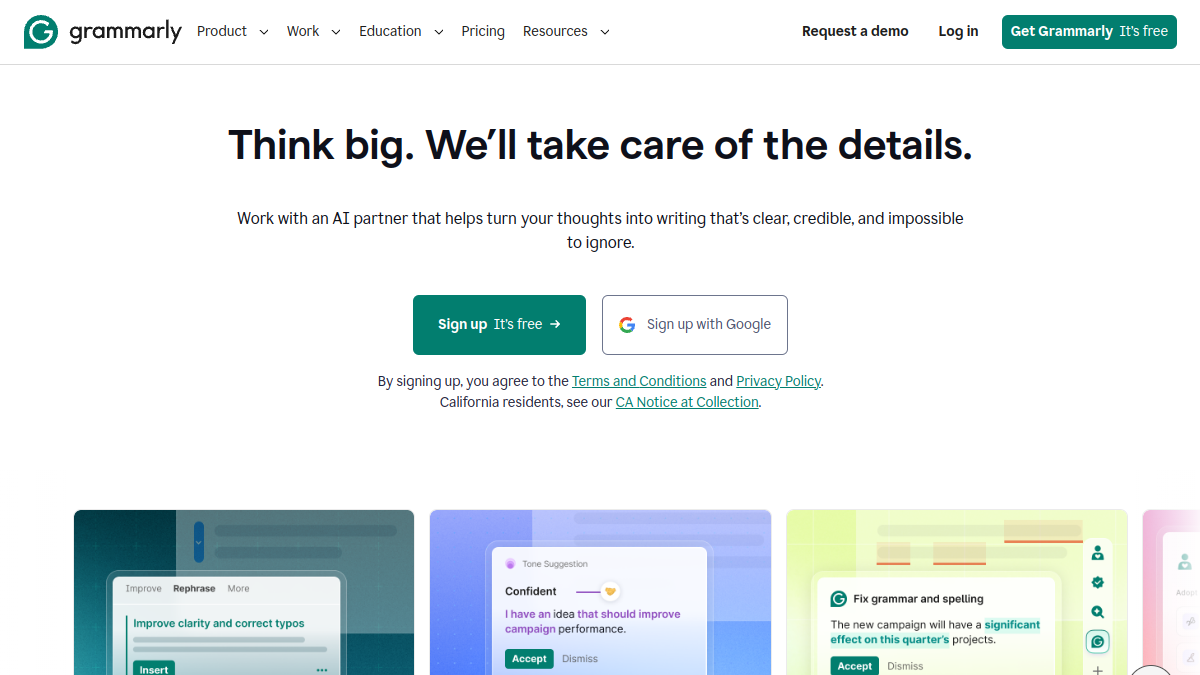
Pro users unlock meaningful capabilities. Full-sentence rewrites, paragraph restructuring, and real-time clarity suggestions operate at paragraph scale, not just word-level fixes. The tone adjuster—marking writing as formal, friendly, confident, or assertive—feels genuinely useful for non-native writers and professionals managing tone-sensitive communication like client proposals or patient notes. Translation support across Spanish, French, Portuguese, German, Italian, Mandarin, Japanese, Indonesian, and Turkish means multilingual teams can compose, refine, and translate without switching tools. Citation Finder automatically sources and formats references, a rare inclusion in writing assistants. The new Grammarly Docs workspace (folded from Coda after Superhuman's acquisition) adds headers, tables, lists, and persistent AI feedback—positioning the tool closer to a full document editor.
Generative AI prompts scale generously: 100/month on Free, 2,000/month on Pro (unlimited on Enterprise). The prompt allowance is genuinely relevant; heavy editors can exhaust 2,000 in a working week, forcing a choice between restraint and upgrade. For serious daily writers, the budget is adequate but not abundant. Style guides and brand tone customization (Pro+) help teams enforce consistent voice, a feature absent in cheaper competitors like LanguageTool ($60/year). Multi-language proofing and rewrites, too, separate Grammarly from narrower competitors—most rivals offer English-only detection.

Grammarly's Free tier is genuinely sufficient for students and occasional writers. It catches real errors, flags tone, and provides 100 monthly AI prompts—no payment required, no credit card demanded. The upgrade case to Pro is strongest for professionals who write daily: journalists, lawyers, managers, non-native English speakers, and marketers. At $144/year, the cost pencils out if it saves even 2–3 hours per month in editing and rework. Users with clinical, legal, or regulatory writing needs report it accelerates compliance and clarity—a tangible ROI.
Casual users and those on tight budgets should stick with Free or consider LanguageTool ($60/year), which offers adequate grammar and spelling detection without generative features. The Expert Review add-on, connecting users to human editors, is a premium layer worth exploring for high-stakes writing (thesis, grant applications) but adds cost beyond Pro. Enterprise buyers must negotiate pricing with sales; published pricing for Business plans no longer exists, having been folded into Pro (1–149 seats) and custom Enterprise tiers.
Grammarly's expansion beyond English is notably advanced. Spanish, French, Portuguese, German, and Italian now support full proofreading and paragraph-level rewrites—not just basic spell-checking. Paragraph rewrites in these languages adjust clarity, tone, and structure in a single click, a rarity amongst competitors. Translation features covering 8+ additional languages including Mandarin and Japanese strengthen its value for global teams. For multinational organisations, this breadth reduces tool sprawl and maintains consistent writing standards across regions and languages.
Team features (Pro tier, 1–149 seats) include group-level security controls, custom roles, audit logs, and cost-centre visibility. Enterprise tiers add SAML SSO, SCIM, BYOK encryption, and DLP—standard but necessary for regulated industries. Parent company Superhuman's 2026 acquisition strategy (email client Superhuman Mail, docs platform Coda/Superhuman Docs) signals Grammarly is being repositioned as the writing layer in a broader productivity suite. Grammarly's integrations with Figma, Asana, Slack, and browser extensions position it as an ambient writing partner rather than a standalone tool—a design choice that explains its 40+ million user base and 50,000 organisational deployments.
Across G2, Capterra, TrustRadius, and Trustpilot, the consensus is robust: Grammarly's core grammar and spelling detection works reliably. Seven out of seven TrustRadius reviewers highlighted effectiveness in identifying errors and refining tone. Professionals report real time savings—one team lead noted Grammarly cut weekly editing time from 20–30 hours to under 15 hours, enabling team scaling without adding headcount. Non-English speakers consistently praise it for building writing confidence in professional settings. Real-time inline suggestions avoid context-switching fatigue that plagues alternatives.
Complaints centre on billing (auto-renewal shock, misleading month-to-month pricing), plagiarism detection accuracy, occasional tone suggestions that flatten natural voice, and integration gaps with some niche tools. Some users note the AI detector (for identifying machine-generated text) produces false positives, a shared challenge across AI detection tools in 2026. No offline mode limits utility for writers on flights or in low-connectivity environments. Despite these irritants, the product itself earns consistent 4.5–4.7 ratings, suggesting weaknesses are friction-based or edge-case rather than fundamental capability failures.
What this review is built on. Our research is AI-assisted and draws on vendor documentation and published user feedback rather than our own lab testing — see the methodology page for the limits of that.
After every long-form review, we publish the two-sided summary. What proved durable, and what failed during testing.
Straight answers to what buyers actually ask, drawn from the documentation and published user reports.