FlexClip Review 2026: Fast Template-First Editor for Social Video, Not Heavy Lifting
Accessible and fast for beginner creators, but limited for professional editing needs.

Accessible and fast for beginner creators, but limited for professional editing needs.

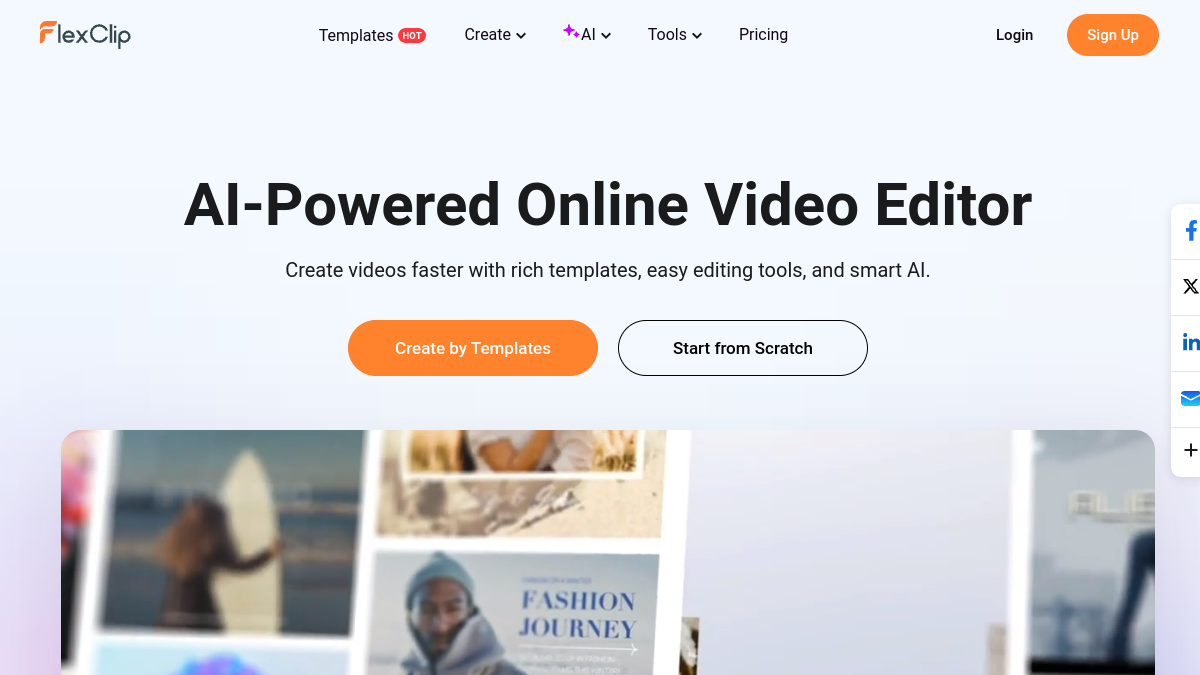
FlexClip has established itself as one of the most approachable online video editors for beginners and small business owners. The platform uses 6,000+ templates, 4M+ stock media assets, and AI tools including text-to-video generation, auto subtitles, and AI script writing. The interface deserves particular credit: users frequently highlight FlexClip's straightforward interface and fast learning curve, with many noting it feels seamless right away, even for first-timers.
The pricing structure offers real value at entry level. Pricing starts free (720p, watermarked) with the Plus plan at $11.99/month (billed annually), which removes the watermark, unlocks 1080p Full HD exports with no length restrictions, provides 5 stock assets per project, 30GB cloud storage, 100GB export storage, and 3,600 AI credits per year (300/month). The Business plan at $19.99/month (billed annually) adds unlimited stock media per project, 100GB cloud storage, 1TB export storage, and 9,600 AI credits annually (600/month).
For creators focused on social media and marketing content, the template library alone justifies the platform's popularity. The template library and 4M+ stock assets genuinely save time, and the AI tools (auto-subtitles, text-to-speech, AI video generation) add real value at the price point.

FlexClip has established itself as one of the most approachable online video editors for beginners and small business owners. The platform uses 6,000+ templates, 4M+ stock media assets, and AI tools including text-to-video generation, auto subtitles, and AI script writing. The interface deserves particular credit: users frequently highlight FlexClip's straightforward interface and fast learning curve, with many noting it feels seamless right away, even for first-timers.
The pricing structure offers real value at entry level. Pricing starts free (720p, watermarked) with the Plus plan at $11.99/month (billed annually), which removes the watermark, unlocks 1080p Full HD exports with no length restrictions, provides 5 stock assets per project, 30GB cloud storage, 100GB export storage, and 3,600 AI credits per year (300/month). The Business plan at $19.99/month (billed annually) adds unlimited stock media per project, 100GB cloud storage, 1TB export storage, and 9,600 AI credits annually (600/month).
For creators focused on social media and marketing content, the template library alone justifies the platform's popularity. The template library and 4M+ stock assets genuinely save time, and the AI tools (auto-subtitles, text-to-speech, AI video generation) add real value at the price point.

FlexClip's single-track timeline architecture fundamentally constrains what it can do. The single video track timeline is a fundamental constraint that prevents multi-layer editing, advanced compositing, and professional-grade workflows. For creators accustomed to desktop software like Premiere Pro or DaVinci Resolve, this will feel immediately restrictive.
Performance also lags. Exporting high-res videos may take time, and mobile performance can lag slightly. Export speeds lag behind desktop software, and heavy projects can choke in the browser. If you're producing long-form or high-resolution content, the browser-based architecture becomes a bottleneck.
The AI credit system, whilst generous in allocation, requires careful budgeting. All AI features consume credits from your plan's annual allocation, and heavy use—especially AI video generation—can exhaust credits within a few months on the Plus plan.
FlexClip's 2026 AI suite has expanded significantly. FlexClip's 2026 AI suite includes auto-subtitle generation, text-to-speech (400+ voices in 140+ languages), AI video generation via Hailuo AI, Kling AI, and Google Veo 3, AI image generation, image-to-image transformation, background removal, noise removal, and the Product URL to Video tool. The auto-subtitles are accurate for clear English audio and save significant manual captioning time, and the AI video generation produces surprisingly usable clips from text prompts.
However, user reviews flag inconsistency. AI-generated video quality varies—it's good for B-roll and social clips, not for hero content. This positions FlexClip as a supplement to manual editing, not a replacement.
FlexClip is best suited for beginners, small businesses, and social media marketers who need polished videos quickly without learning complex editing software, though its single video track and slow export speeds limit its usefulness for advanced editors. If you're producing YouTube shorts, Instagram reels, LinkedIn marketing content, or educational videos—and you want to avoid expensive software and steep learning curves—FlexClip delivers.
Skip it if you're editing multicam footage, building complex layered compositions, or producing content that demands frame-perfect technical control. If your editing involves multicam, complex transitions, or long-form content, look at Descript or a desktop editor instead.
FlexClip occupies a genuine middle ground in the video-editing market. It's too simple for professionals but packed enough for ambitious creators wanting speed over granular control. FlexClip ranks #11 of 18 in AI Video Generators, holds a 3.8/5 editor rating, and starts at $11.99/month (12% below the $14/mo category average). At that price, with unlimited templates and stock media once you're on a paid plan, the value is evident for the target audience.
Users report consistent satisfaction with the core product. It's a great choice for creating clean, polished videos quickly, especially if you want a tool that's easy to learn, and even with a few limitations, the simplicity, speed, and convenience make it a strong option for everyday video projects. The caveats are real—export speed, single-track limitation—but for the use cases FlexClip targets, they're acceptable trade-offs.
What this review is built on. Our research is AI-assisted and draws on vendor documentation and published user feedback rather than our own lab testing — see the methodology page for the limits of that.
After every long-form review, we publish the two-sided summary. What proved durable, and what failed during testing.
Straight answers to what buyers actually ask, drawn from the documentation and published user reports.