Dorik 2026: The Lifetime-Deal Website Builder That Actually Delivers on Simplicity
Beautiful sites, zero code, exceptional value—especially via lifetime deals.

Beautiful sites, zero code, exceptional value—especially via lifetime deals.

Prices, plan contents and limits as Dorik publishes them, read on 1 October 2026. 1 source.
Public user feedback and independent review platforms, used for recurring patterns rather than single opinions.
Our reading of the evidence and the score. No hands-on testing — see the methodology.
Dorik's lifetime deals at $249 (Personal) and $599 (Business) represent extraordinary value in the website-builder landscape. For freelancers and small agencies building 2+ sites, the lifetime deal pays for itself within 12–24 months compared to recurring subscription costs. Dorik sells both plans directly (checked 13 September 2026). The $249 Personal lifetime plan costs the same as one year of Personal billed annually, and the $599 Business plan about 14 months of the $498-a-year Business subscription — so either pays for itself during the second year, and over ten years costs roughly $2,200–$4,400 less than subscribing. The platform explicitly allows export of clean HTML/CSS/JS, mitigating vendor lock-in—a critical reassurance for lifetime-deal buyers nervous about platform abandonment.
Dorik's drag-and-drop interface ranks among the most intuitive in the no-code space. Users consistently praise the simplicity: "I built my freelance site in 30 minutes" and "no learning curve" appear across verified reviews on G2 and Capterra. The AI website generator—type a description, wait 60 seconds, receive a fully styled multi-page site—removes the blank-page paralysis many beginners face. All 250+ UI blocks, 100+ templates, and pre-designed sections are free on every tier; users aren't nickel-and-dimed for premium designs.
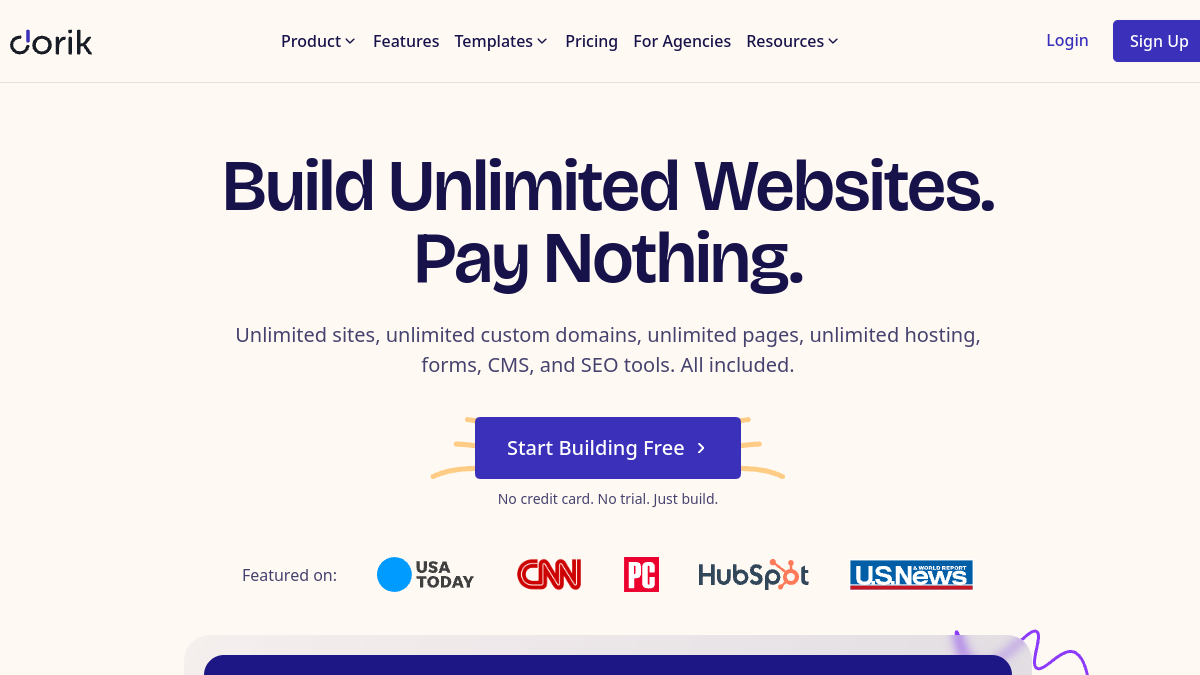
Critically, the free plan doesn't disguise itself as a trial. You genuinely build unlimited sites with unlimited custom domains, storage, and bandwidth. One reported friction point: the 2024–2025 transition saw confusion when Dorik briefly switched to a trial model for some free-plan users without clear communication—a stumble the company has largely rectified. Respondents note that responsive customer support mitigates complexity: support staff provide screen recordings and custom code assistance for non-technical users.
Websites built on Dorik load exceptionally fast. PageSpeed Insights scores routinely hit 90+ on standard test sites, outperforming WordPress and basic builders in side-by-side comparisons. The infrastructure leverages AWS, DigitalOcean, and BunnyCDN across 150+ global locations with claimed 99.9% uptime and unlimited bandwidth. Every site automatically receives free SSL via Let's Encrypt, eliminating recurring security costs.
SEO capabilities are comprehensive: auto-generated sitemaps, customisable meta tags, Open Graph support, hreflang attributes for multi-language sites, and built-in Google Analytics/Facebook Pixel integration. The drag-and-drop editor permits pixel-level design control without sacrificing performance—a balance many builders fail to strike.
Despite its strengths, Dorik has documented limitations. The editor occasionally lags on complex, multi-page projects; users managing 50+ pages or intricate nested structures report slowdowns. Template variety—whilst respectable at 100+—trails competitors like Wix or Squarespace. Advanced customisation seekers comparing Dorik to Webflow will find fewer granular controls; the platform optimises for simplicity over flexibility, a deliberate trade-off.
E-commerce remains rudimentary: Dorik handles single-product Gumroad/PayPal integration and supports Shopify/Ecwid connectors, but lacks native inventory management, multi-variant products, or abandoned-cart automation. Scaling a $100k+ online store elsewhere is prudent. Historically, a subset of users encountered inconsistent support and unclear feature communication. Today's support is generally responsive, but negative reviews citing poor communication persist in older archives—a reminder that new users should test responsiveness during onboarding.
Dorik occupies a sweet spot between simplicity (Carrd) and power (Webflow). Compared to Wix or Squarespace, Dorik charges significantly less ($0/month free tier vs. $10–$18/month custom domain fees), includes unlimited sites per subscription, and excels in white-label agency tools. Its AI website generator is faster than Durable for initial setup but offers more design control post-generation. For WordPress migrations, Dorik's CMS is simpler—no plugins, themes, or server management—though WordPress offers vastly more extensibility.
The lifetime-deal category elevates Dorik further. Competitors rarely offer genuine permanent access; Dorik's transparency about the product's roadmap and technical architecture (open export, no forced migration) builds buyer confidence in 10+ year ownership horizons.
Dorik excels for: freelancers building client portfolios, small agencies white-labeling for resale, content creators launching blogs, solo entrepreneurs testing business hypotheses, and students building portfolio sites. The lifetime deals represent exceptional value for anyone planning 5+ years of website ownership.
Avoid Dorik if: you need Shopify-grade e-commerce, require advanced technical customisation, or demand the design flexibility of Figma-driven builders. WordPress remains superior for heavily customised blogs; Shopify for inventory-heavy stores; Webflow for design perfectionism.
In 2026, Dorik ranks among the most honest no-code builders. Pricing is transparent, feature limitations are acknowledged, and the free plan isn't a bait-and-switch. For lifetime-deal buyers, the combination of zero lock-in (via code export), responsive support, and clear value retention over 10 years makes Dorik an uncommon exception in the often-risky lifetime-software space.

What this review is built on. Our research is AI-assisted and draws on vendor documentation and published user feedback rather than our own lab testing — see the methodology page for the limits of that.
After every long-form review, we publish the two-sided summary. What proved durable, and what failed during testing.
Straight answers to what buyers actually ask, drawn from the documentation and published user reports.
The Lifetime Deals Desk covers one-time "lifetime" software deals, compared on the one-time price, the tiers on offer and whether the deal is still live. Reviews are research-based and AI-assisted. They draw on each vendor's published pricing — including what plans renew at where that is disclosed — documented features, and patterns in public user reviews. Prices on a review are dated. The desk does not run hands-on benchmarks or tests, and no vendor pays for coverage, a score or a position.
Pricing on this page was taken from the vendor's published pricing page on 1 October 2026.