Independent reviewsno sponsored placements
Review4 min readSeptember 13, 2026

Datadog 2026 Review: Enterprise Observability Trade-offs Between Capability and Cost Control

Comprehensive platform excellence undercut by unpredictable billing complexity and steep configuration learning curve.

Admin
Research basisresearch-based
Datadog 2026 Review: Enterprise Observability Trade-offs Between Capability and Cost Control
Product reviewed
Datadog
Real-time unified observability with powerful analytics, but bills often run 2-3x estimates once logs and metrics compound.

The quick verdict

Scroll for the full review ↓

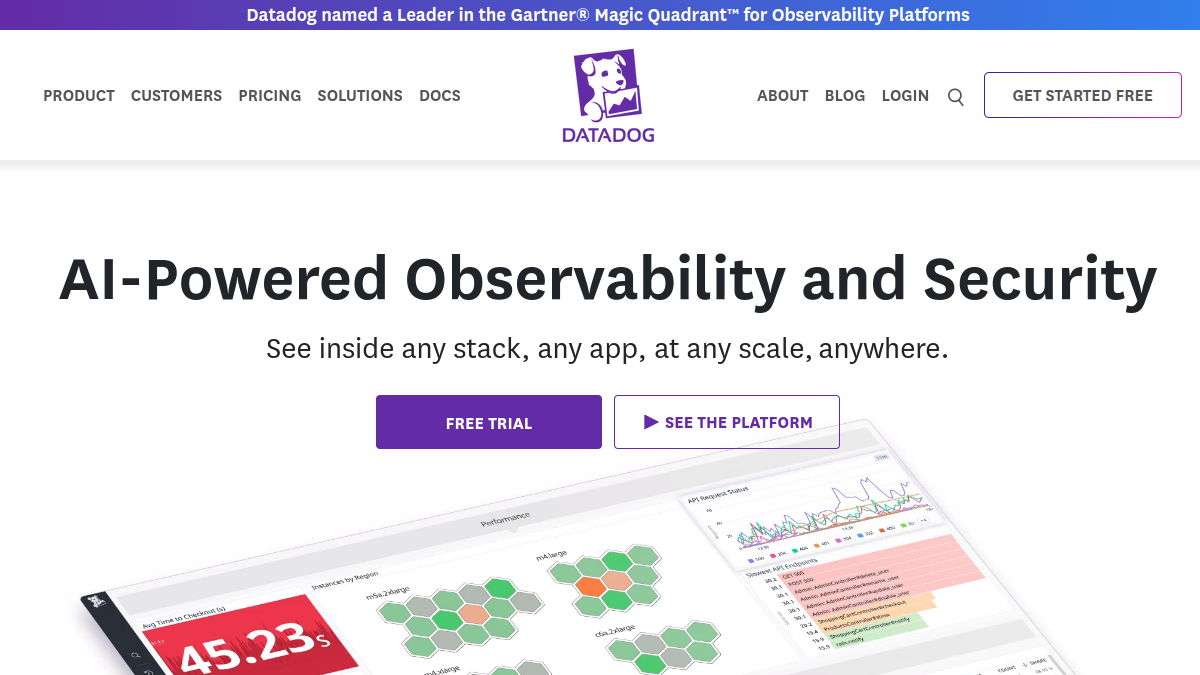
Datadog has established itself as the de facto standard for cloud infrastructure monitoring and application observability. The platform aggregates metrics, logs, traces, and security signals into a single unified interface—a significant operational advantage for teams managing distributed systems. Users consistently praise the real-time monitoring capabilities and the platform's ability to consolidate data that would otherwise require switching between multiple siloed tools.

The core strength lies in breadth. Infrastructure monitoring, application performance monitoring with distributed tracing, log management, network monitoring, database query-level visibility, real user monitoring with session replay, synthetic testing, and cloud security with threat detection and CI/CD pipeline observability are all accessible from one place. Users highlight the platform's real-time notifications, data connectors, and data visualization capabilities as its top features, and Datadog was named a FrontRunner with an overall rating of 4.6/5 stars based on verified user reviews.

7.8/10
RC Score

01 / 06Section 1

Datadog has established itself as the de facto standard for cloud infrastructure monitoring and application observability. The platform aggregates metrics, logs, traces, and security signals into a single unified interface—a significant operational advantage for teams managing distributed systems. Users consistently praise the real-time monitoring capabilities and the platform's ability to consolidate data that would otherwise require switching between multiple siloed tools.

The core strength lies in breadth. Infrastructure monitoring, application performance monitoring with distributed tracing, log management, network monitoring, database query-level visibility, real user monitoring with session replay, synthetic testing, and cloud security with threat detection and CI/CD pipeline observability are all accessible from one place. Users highlight the platform's real-time notifications, data connectors, and data visualization capabilities as its top features, and Datadog was named a FrontRunner with an overall rating of 4.6/5 stars based on verified user reviews.

02 / 06Section 2

Pricing: Hidden Complexity Beyond the List Price

Datadog's commercial model is perhaps its most divisive aspect. Datadog pricing is modular and usage-based, with Infrastructure Monitoring starting at $15 per host per month billed annually, APM at $31 per host per month, and Log Management at $0.10 per GB for indexed logs plus $1.27 per million ingested events. This granular metering initially appears reasonable for small deployments.

Reality diverges sharply. Most teams find their actual Datadog bill runs 2 to 3x higher than initial estimates once logs, APM, and custom metrics start compounding across independent billing dimensions. Datadog uses a high-water mark model: it measures your host count every hour, discards the top 1% of hours, and bills you for the entire month based on the next highest hour, meaning temporary scaling for deployments or load spikes incurs full-month charges. Custom metrics are billed at $5 per 100 metrics per month, with volume discounts available down to $1 per 100 at higher scale, creating an invisible cost vector. For context, average SMB pricing for Datadog is $123,502 per year, while average enterprise pricing is $709,819 per year based on actual customer data.


03 / 06Section 3

User Experience: Power Tempered by Complexity

Users consistently praise real-time monitoring and the intuitive dashboards that simplify tracking application performance and infrastructure health; the platform's ability to consolidate logs, metrics, and traces into a single view enhances troubleshooting efficiency, making it easier to identify issues quickly. However, complexity is the flip side of capability. It is complex—very, very complex. While there are things that are extremely easy to use in Datadog, overall, the entire suite is very sophisticated and complex.

Some of the internal documentation isn't updated very often, so that you occasionally have setup instruction mismatches between their page and vendors. New users often find the onboarding steep, particularly when configuring custom metrics, log filters, or advanced alerting rules. Minor, non-critical fluctuations triggered alerts, which led to unnecessary noise and some alert fatigue among the team, a recurrent complaint about default alert sensitivity.

04 / 06Section 4

Reliability and Platform Stability

Datadog has shown excellent stability, with minimal downtime and reliable performance; users consistently report no significant outages, even during peak usage, and quick resolution of minor issues. Uptime and efficient resource usage are often praised; occasional minor hiccups are mentioned but are resolved swiftly, maintaining trust in the platform for consistent monitoring and observability tasks across multiple environments. From an infrastructure perspective, Datadog rarely disappoints.

05 / 06Section 5

Integration and Ecosystem

Over 1,000 out-of-the-box integrations allow teams to monitor existing tools without replacing them. This breadth is genuinely valuable—native connectors to AWS, Azure, GCP, Kubernetes, Postgres, and hundreds of third-party SaaS tools reduce friction and eliminate the need to build custom collectors. Seamless integration with cloud platforms like AWS and Azure simplifies onboarding, and flexible alerting and extensive integration options, including Slack and PagerDuty, ensure timely responses to incidents.

06 / 06Section 6

Who Should Buy

Datadog excels in organisations with mature cloud infrastructure, high-scale distributed systems, and teams with budget flexibility to absorb pricing complexity. It's valuable for companies running microservices, Kubernetes clusters, or hybrid cloud deployments requiring unified observability. Datadog excels in environments with microservices, containers, and hybrid infrastructure, but may feel complex for smaller teams. For cost-sensitive organisations or those without substantial infrastructure scale, the platform's per-host and per-event metering creates a poor unit economics profile. Teams should model actual usage before committing and implement aggressive tag and metric cardinality discipline from the start.

How we researched this

The research basis

What this review is built on. Our research is AI-assisted and draws on vendor documentation and published user feedback rather than our own lab testing — see the methodology page for the limits of that.

Duration
research-based
continuous monitoring
Test count
distinct tests
Testers
contributors
Sponsored?
No
Editorial integrity
What we observed

The honest summary

After every long-form review, we publish the two-sided summary. What proved durable, and what failed during testing.

What held up

4 items
  • +Real-time unified observability across metrics, logs, traces, and security signals genuinely consolidates previously siloed tooling
  • +Platform stability and uptime remain excellent with minimal incidents and fast resolution
  • +1,000+ integrations ecosystem eliminates vendor lock-in and accommodates existing toolchain
  • +AI-powered anomaly detection and root cause analysis meaningfully accelerate incident response for mature teams

What broke

4 items
  • Pricing complexity: actual bills routinely 2-3x initial estimates due to compounding usage meters and high-water mark billing
  • Steep learning curve and complexity; platform requires sophisticated operators; documentation occasionally outdated
  • Alert fatigue from false positives despite customisation options; minor fluctuations trigger unnecessary noise
  • Unpredictable cost scaling: temporary infrastructure spikes lock in full-month charges; custom metrics and log indexing act as hidden cost multipliers
Common questions

What people ask about Datadog

Straight answers to what buyers actually ask, drawn from the documentation and published user reports.

How much does Datadog actually cost for a typical mid-sized team?
Based on 2026 spend data, average SMB annual spend is $123,502. List pricing starts at $15-23 per host/month for infrastructure monitoring, but actual costs are typically 2-3x higher once APM, logs, and custom metrics accumulate. A 50-host team running APM and Infrastructure Monitoring pays around $2,300/month before logs.
Is Datadog worth the cost?
Datadog's comprehensive feature set and reliability justify the spend for large organisations with sophisticated infrastructure and dedicated FinOps oversight. For smaller teams or those with budget constraints, the complexity-to-value ratio is less favourable; competitors with simpler pricing (e.g., cost-per-GB models) may offer better economics at smaller scale.
How difficult is it to implement Datadog?
For straightforward infrastructure monitoring and cloud integrations, onboarding is relatively quick. However, extracting full value requires significant tuning: configuring alerts, building dashboards, setting up custom metrics, and managing log cardinality all demand expert knowledge. Documentation gaps and occasional vendor integration mismatches add friction.
What are the main complaints about Datadog?
Recurring complaints centre on pricing unpredictability (bills scaling faster than expected), platform complexity (steep learning curve), alert fatigue from false positives, and the high-water mark billing model penalising temporary infrastructure spikes. Support response times vary, and some users report documentation is not always current.
A
Written by

Admin

Datadog 2026 Review: Enterprise Observability Trade-offs Between Capability and Cost Control · ReviewCost